

One of the longest-running legal battles of the #MeToo era made headlines again last month, when the Bombay High Court overturned the acquittal of former Tehelka magazine editor Tarun Tejpal in a 2013 case and sentenced him to 10 years in prison for raping a colleague.
With Tejpal already filing an appeal in the Supreme Court against this verdict, this case is a reminder of how long the legal and social afterlife of sexual-assault allegations can be.
The hashtag #MeToo, which was launched in 2006 by American civil-rights activist Tarana Burke as a way to build solidarity and empathy among survivors of sexual assault, grew into a global conversation about sexual harassment, assault, impunity and power. One of the largest social-media campaigns in history, it gained worldwide attention in 2017 after The New York Times published investigative reports about Hollywood producer Harvey Weinstein.
Social media gave women a way to speak outside institutions that had often failed them. In South Asia, particularly India, #MeToo became a tool to challenge powerful men across film industries, newsrooms and the business world.
But what happens after a perpetrator is exposed? Cases like Tarun Tejpal, spanning more than a decade, remind us that social reckoning does not always lead to swift justice.
And what happens inside a marriage when a husband is publicly exposed for sexual misconduct? What does his wife know, or not know? What happens to the life they built together?
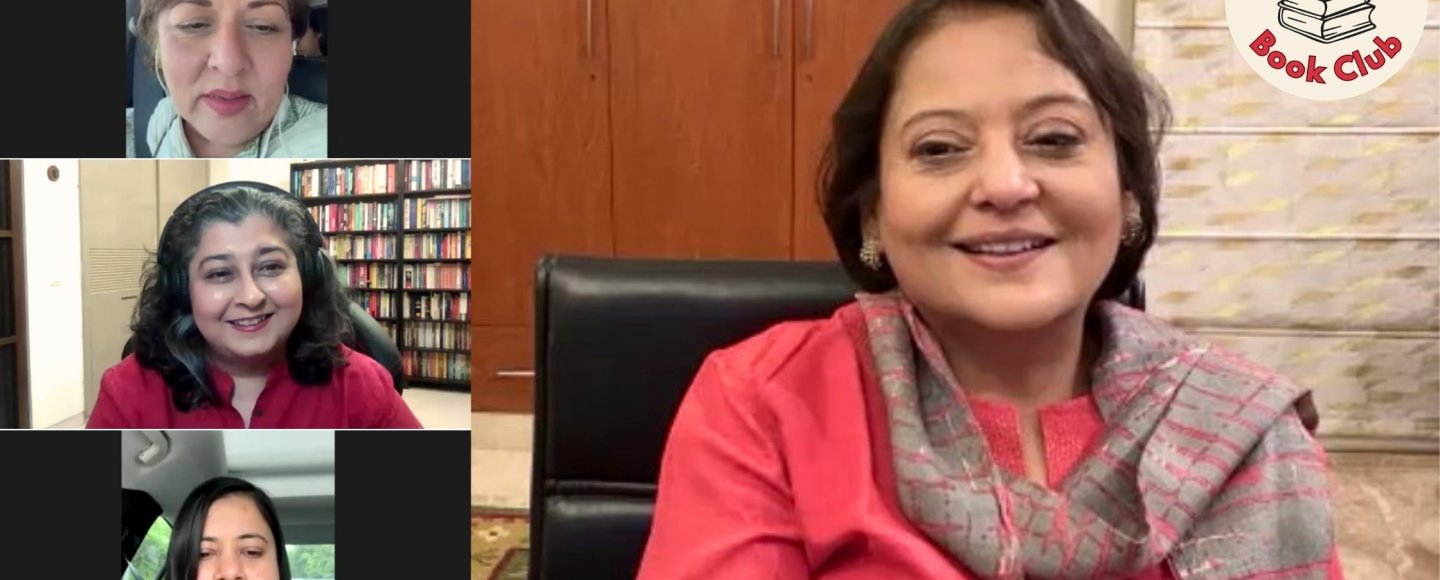
Those questions were at the heart of eShe’s fourth Book Club discussion, where eShe founder and editor Aekta Kapoor spoke with journalist and author Shuma Raha about her latest novel, The Sea Has the Answers (Niyogi Books).
Rather than revisiting #MeToo only through the familiar lens of survivors and perpetrators, the discussion examined what happens to the people around them – wives, children, families and community. The novel’s parallel subplots also illustrate that sexual misconduct cuts across corporate, rural and religious spaces.
The wife of the accused
Kapoor opened the conversation with a deceptively simple question: “What did you feel when you first heard about #MeToo?”
For Raha, the question went back to the early days of India’s #MeToo movement. She was struck by the courage it took for women to speak out. But as the movement unfolded, she also began noticing what was missing from the conversation: the wife’s story.
Her novel follows Urmi, a 43-year-old homemaker whose seemingly stable 19-year marriage falls apart after her husband, Shankar, a powerful corporate honcho, is exposed as a serial sexual predator in the workplace.
But Raha’s interest was not in retelling a survivor’s story. It was in asking what it means for a woman to rebuild her life after discovering that the person she trusted most is not who she believed him to be.
Why don’t women leave?
As the discussion took participants down memory lane about #MeToo, the conversation soon moved beyond the novel itself. Participants questioned why women don’t leave unfaithful marriages, even when their partners have committed sexual crimes.
Raha explained that Urmi’s need for emotional security shaped Urmi’s choices. Having grown up watching her father emotionally mistreat her mother, Urmi had long wanted a marriage that would give her the stability and affection she felt she had been missing.
“People say the wife always knows. But some of us do not act. Knowing and acting on that knowledge are very different things,” said Raha.
The discussion then turned to financial dependence, especially when the wife is a homemaker or has limited means. US-based physician and eShe Book Club member Fauzia Deeba questioned whether concerns about the children also played a role in women’s minds.
eShe’s managing director Sarita Bartaula argued that women’s decisions to remain in difficult or abusive relationships are not always financial; they can also be shaped by social and cultural conditioning. “Finance does play a significant role, but it’s not always about finance,” she said. “Are women in our culture taught what an abusive marriage looks like? Do they know the red flags? Do they know when to leave?”
The question is particularly relevant in South Asian societies, where marriage can come with expectations about family, reputation, motherhood and endurance. Women may be taught how to become wives and mothers long before they are taught how to recognize an unhealthy relationship.

That led to another uncomfortable question: what is the price of staying, and the price of leaving? For many women, particularly in South Asian cultures, the barriers begin long before money becomes an issue.
Sometimes the social cost outweighs the economic cost. There is family pressure, social reputation, cultural conditioning, fear of being judged, fear of disrupting children’s lives, and the internal struggle of admitting that the marriage everyone believes is successful may actually be harming them.
How well do we know the person we marry?
eShe Book Club member Anisha Khaniya, attending the event from London, UK, mused, “How much do we really know the person we marry?”
The discussion also turned to arranged marriage, a reality for many South Asian families, where couples may enter marriage with limited or even no knowledge of each other’s lives, relationships, expectations and values.
How much can someone really know about another person before building a life with them? And how much of marriage is based on trust, assumptions and the belief that people will reveal themselves over time?
For Urmi, that trust became part of the tragedy. She had built her understanding of Shankar around the man she knew at home, while the other side of his life remained hidden from her.

The family pays the price
The protagonist Urmi’s decision to leave her husband Shankar has unintended consequences for their 17-year-old daughter. That tension adds another layer to the novel. A woman’s decision to reclaim her life may be liberating, but it does not mean the people around her escape the consequences.
One of the novel’s most uncomfortable literary choices is that readers also enter Shankar’s mind. He sees himself as the victim rather than the perpetrator. He resents the women who accused him. He is furious that his wife has left him. He believes she should be standing beside him, helping him manage the crisis.
That raises a central question in the novel: why should the wife and daughter have to suffer for what the husband has done?
What happens after #MeToo?
Deeba asked whether perpetrators actually face lasting consequences once the #MeToo spotlight fades.
Raha said many men did lose their jobs, but some eventually found work elsewhere. In the novel, the possibility of Shankar’s rehabilitation, Raha said, shows a larger reality: the public scandal may fade, but the consequences are rarely distributed equally. Men may eventually return to their careers, while the women and families affected are left to live with what happened.
In this context, Bartaula brought up the example of Bill and Hillary Clinton – the husband who strayed and took advantage of a much younger colleague, and the wife who stayed in the marriage even though she was an empowered, educated feminist.
While Bill went on to become President of the United States for a second time, it was Hillary who paid the price when it was her turn to stand for the presidency: “One of the reasons she lost was that she did not stand up for herself,” Bartaula pointed out.
Beyond #MeToo
By the end of the discussion, the questions raised by The Sea Has the Answers extended beyond Shankar and Urmi.
Raha said she hopes the novel adds to a larger conversation about women’s freedom from the expectations that shape their lives. Women are often told they have to marry, have children, preserve the family and compromise. Urmi’s journey challenges those expectations by asking whether a woman can choose a different life, even after nearly two decades of marriage.
Whether it be the premise of Shuma Raha’s novel or the longstanding case of Tarun Tejpal, the discussion leaves a bigger question. The #MeToo movement changed how society talks about sexual misconduct and accountability. But the consequences do not end when the headlines do.
Beyond the question of whether an accused man is held accountable is another one: who bears the cost in the years that follow, and what happens to the wives, children and families left to live with it?
Inputs by Aarati Paudel
This Book Club discussion is also available as a podcast on Spotify.
Discover more from eShe
Subscribe to get the latest posts sent to your email.
0 comments on “The other side of #MeToo: from Tarun Tejpal to the story of a perpetrator’s wife”