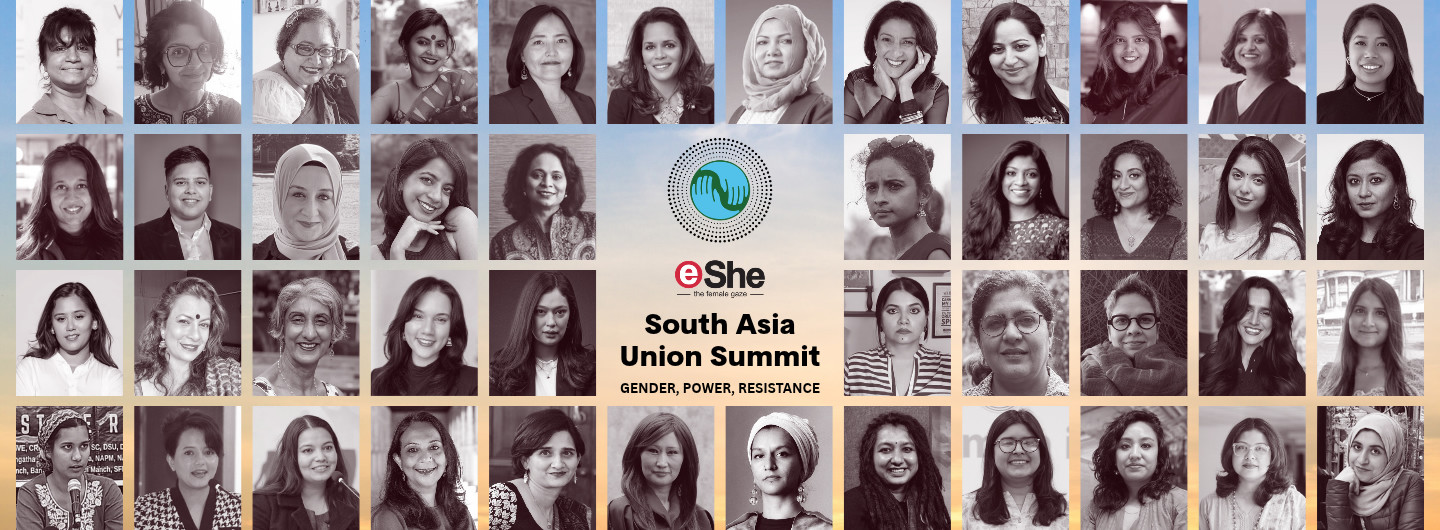
Over three days this November, eShe brought together leaders, practitioners and young changemakers from around the world for vibrant conversations on democracy, gender, identity, climate, culture, technology and the issues shaping our collective future.
Theme: Gender, Power, Resistance
Dates: 13 – 15 November 2026
Format: Virtual (Zoom live)
The Summit came at a time when global peace, women’s safety, climate justice and democratic freedoms are increasingly under threat regionally and globally. We invited global thinkers, grassroots changemakers and women leaders from across South Asia and the diaspora to gather, find common ground across borders, and help chart a roadmap forward toward a just, inclusive and more compassionate world.
From media censorship to women’s political activism and the changing meaning of ‘progress’ and belonging, South Asia Union Summit 2026 created space for perspectives, questions and conversations that cross national boundaries.
Notable speakers at past Summits have included a diverse array of voices, including peacebuilders Dr Scilla Elworthy and Dr Meenakshi Gopinath; actor and activist Nandita Das; award-winning filmmakers such as Leslie Udwin, Sabiha Sumar, Alankrita Srivastava and Mehreen Jabbar; thought leaders Dr Radha Kumar and Karen Downes; activists Hina Jilani, Ambika Satkunanathan and Manjula Pradeep, besides many more.
PROGRAM
Times are shown in US Eastern (EST) and India (IST). Registered participants who attended the virtual sessions on all three days will receive a digital Certificate of Participation.
Find all sessions on this YouTube playlist.
13 November 2026, Friday
Day 1
Keynote Session
13 November, 08.00 AM EST / 06.30 PM IST
S. Mona Sinha, global executive director and CEO of Equality Now, gender justice philanthropist; US National Women’s Hall of Fame inductee (2026)
Panel 1: Who Counts as ‘Us’? Nationalism, Migration and the Minority Question
13 November, 09.00 AM EST / 07.30 PM IST
To examine how majoritarianism, under the banner of nationalism, is reshaping who counts as “us” in South Asia and USA.
Dr Ruchika Sharma, public historian, PhD from Jawaharlal Nehru University, former media fellow at University of Essex, YouTuber
Jayaa Jaggi, intersectional feminist, minority rights activist, peacebuilder, founder of SheMatters Pakistan
Dr Marufa Akter, specializing in Bangladesh women’s political participation, gender and governance, and conflict resolution
Hurunnessa Fariad, Afghan-origin American community leader advancing multi-faith peacebuilding in US, subject of the documentary Her Anthem (2025)
MODERATOR: Dipti Nagpaul, award-winning journalist, doctoral student at the University of Sheffield, post-detention advocacy coordinator at Gatwick Detainees Welfare Group, UK
Panel 2: Who Owns the Intelligence: AI, Technology and Systemic Bias
13 November, 11.00 AM EST / 09.30 PM IST
To examine how AI and digital technologies can reproduce gender, caste, class and racial inequalities, and who builds, benefits from and bears the costs of these systems.
Chaitra Vedullapalli, award-winning technology entrepreneur; cofounder and president of Women in Cloud, Seattle
Shreya Krishnan, managing director, AnitaB.org India; chair, Policy Advocacy Committee, UNESCO Women for Ethical AI (South Asia)
Dr Shivangi Narayan, independent researcher specializing in tech and society, author, educator, former engineer and journalist, PhD in Sociology from Jawaharlal Nehru University, Delhi
Priyasha Maharjan, DC-based global health leader, former Fulbright Fellow, researcher focused on AI-enabled healthcare, cofounder and director of Samartha Nepal Janata Clinic
MODERATOR: Prakriti Bhattarai Basnet, Nepali activist and political figure, technology public policy scholar, University of Oxford alumnus
14 November 2026, Saturday
Day 2
Keynote Session
14 November, 06.00 AM EST / 04.30 PM IST
Dr Aishath Rafiyya, Maldivian political leader and former diplomat, CEO of the Global Peace Institute, London, and the first woman elected Vice President of a political party in the Maldives
Panel 3: From Object to Author: When Women Control the Frame in Cinema
14 November, 07.00 AM EST / 05.30 PM IST
To examine how South Asian women filmmakers are disrupting the patriarchal hierarchies of the industry, with a focus on authorship, representation and narrative power.
Shazia Iqbal, Indian filmmaker and former production designer, director-screenwriter of the award-winning short Bebaak, feature film Dhadak 2 and docu-drama Homecoming
Anam Abbas, feminist filmmaker, director of This Stained Dawn about Pakistan’s Aurat March, producer of Showgirls of Pakistan and In Flames, cofounder of Documentary Association of Pakistan
Sulochana Peiris, documentary filmmaker, researcher and writer; creator of GoHomeGota, a documentary about Sri Lanka’s 2022 Aragalaya mass protest movement
MODERATOR: Sonali Gulati, independent filmmaker, feminist and queer rights activist, film studies professor, USA
Panel 4: Truth Under Fire: Media Censorship and Propaganda Press
14 November, 08.30 AM EST / 07.00 PM IST
To examine how censorship, state pressure and propaganda are shaping what people can read, watch and say, and who pays the price when journalism is silenced.
Anuradha Bhasin, senior journalist, managing editor of Kashmir Times, internet-freedom activist, author of A Dismantled State: The Untold Story of Kashmir After Article 370
Zahra Nader, founding editor-in-chief of award-winning Afghan women-led newsroom Zan Times, formerly with The New York Times bureau in Kabul
Niha Masih, award-winning international correspondent with reporting experience from a dozen countries; writer, This is India newsletter, The Guardian; formerly with The Washington Post
MODERATOR: Natasha Badhwar, author, filmmaker, columnist, teacher and writing coach; two-time winner of Laadli Media Award
Panel 5: Body as Battleground: Gender, Sexuality, Culture and Resistance
14 November, 10.00 AM EST / 08.30 PM IST
To examine how bodies, sexuality and gender norms become sites of control and of resistance, and how culture, religion, and the state shape women’s and queer people’s bodily expression and wellbeing.
Farah Ahamed, human-rights lawyer, editor of Period Matters: Menstruation in South Asia, founder of Kenyan charity Panties with Purpose
Paromita Vohra, filmmaker, feminist artist, founder and creative of Agents of Ishq, a platform for positively representing sex in India through various media forms
Farzana Doctor, Toronto-based author, social worker and psychotherapist; prominent activist against female genital cutting/mutilation
MODERATOR: Suparnaa Chadda, media personality, UN Women WEP Awardee, founder of SABERA Awards
Special talk: Social Justice at the Intersection of Gender, Race, Culture and Class
14 November, 11.30 AM EST / 10.00 PM IST
Dr Kindy Sandhu, British academic researcher, the first South Asian and ethnic minority woman to be appointed to the Coventry City Council Cabinet as Cabinet Member for Education and Skills.
15 November 2026, Sunday
Day 3
Keynote Session
15 November, 05.30 AM EST / 4.00 PM IST
Lily Wangchuk, pioneering Bhutanese leader, former diplomat, politician, author and advocate for women’s leadership and inclusive governance; first woman in Bhutan to lead a political party
Panel 6: The Future of Democracy: Gen Z, Women and Political Activism
15 November, 06.30 AM EST / 05.00 PM IST
To examine how women political activists, and especially younger women, are leading from the front when it comes to challenging increasingly authoritarian leadership, divisive rhetoric and political violence in South Asian democracies.
Umama Fatema, prominent student leader and democracy advocate, recognized for her leadership during the historic July–August 2024 mass uprising in Bangladesh
Nadia, Delhi State President of Students Federation of India (SFI), actively involved in 2026 Gen-Z protests in Delhi, India
Fatima Shahzad, Pakistani student movement leader, political artist, youth rights and social justice advocate
Monika Niroula, queer feminist activist, one of the primary drafters and negotiators of the 10-point agreement signed between the Gen-Z led people’s movement and the Government of Nepal
MODERATOR: Trishia Nashtaran, feminist activist, community organizer and foresight strategist; founder of Meye Network, Bangladesh
Panel 7: Who Pays for Progress? Climate Change, Gender and Neocolonialism
15 November, 08.00 AM EST / 06.30 PM IST
To examine who bears the costs and who holds the power in the global climate transition, resource extraction, adaptation and development.
Manshi Asher, prominent Indian environmental justice activist and researcher; co-founder Himdhara Environment Research and Action Collective in Himachal Pradesh
Goma Karki, program director, Youth Innovation Lab, former lead Nepali Yuwa in Climate Action and Green Growth, Nepal
Melani Gunathilaka, climate justice activist, researcher, gender and human rights advocate, cofounder of Climate Action Now Sri Lanka
MODERATOR: Priscilla Ranjitkar, sustainability and transportation demand management professional based in Washington, DC
Panel 8: Gender Activism 4.0: Influencers, Cyberfeminism and Digital Cultures
15 November, 09.30 AM EST / 08.00 PM IST
To examine how digital platforms are changing feminist activism, from influencers and online campaigns to cyberfeminist movements and the digital cultures they create.
Priya Sigdel, Nepali human rights activist, Miss Nepal Earth 2018, cofounder and president of the feminist nonprofit Hatti Hatti Nepal
Muskan Madaan, Indian digital creator, feminist influencer and speaker originally from Punjab, India
Maisha ‘Priooty’ Mahjabeen, Bangladeshi content creator, gender equality advocate, and Master of Social Work student at the University of Melbourne
Sofia Shah, content creator based in LA, founder of She Builds Nepal, former Nepali national swimmer and advocate for women in sport
MODERATOR: Sunila Lohia, fashion influencer and biotech professional working in generative AI, Washington, DC
Panel 9: Patriarchy, ‘Purity’ and Power: Breaking the Chains of Caste and Gender
15 November, 11.00 AM EST / 09.30 PM IST
To expose how caste and patriarchy combine to turn women into guardians of “purity”, how Dalit and other marginalized women are hit hardest, and how families, religious institutions and the state keep these hierarchies in place.
Christina Dhanuja, author, cofounder of the #DalitHistoryMonth project and a founding member of the Global Campaign for Dalit Women
Bridhika Senchury, prominent Nepali social activist, researcher and media producer; co-founder and campaign lead of the Dalit Lives Matter Global Alliance
Divya Kandukuri, writer and cultural organizer; founder, The Blue Dawn; anti-caste mental health and feminist care advocate
MODERATOR: Shailee Chaudhary, human-rights lawyer, Australia Awards Scholar, queer feminist activist
EVENT SUPPORTER:

AMBASSADORS:
Sabin Muzaffar, founder and executive editor, Ananke magazine, Dubai
Mehr F Husain, founder, Zuka Books, author, cultural advocate, former director of Pakistan’s National History Museum, sustainable development professional
PANEL HOSTS:
Dr Uroosa Mushtaq, Doctoral Fellow (Cotutelle Researcher), Centre for Peace and Security, Coventry University, UK
Dr Nilanjana Sen, ethnographer and development practitioner whose work examines youth agency, ethics and everyday decision-making
Isha Jerath, EU policy engagement and sustainability professional based in Brussels; former President, AIESEC Belgium
Nichole Smith, graduate lecturer and PhD student of Cultural Studies at George Mason University, DC, specializing in social movements, Marxist feminism and anti-rape activism
Dipisha KC, refugee rights advocate, University of Virginia graduate in Global Security and Justice, project manager at the Bhutanese Community of Central Ohio
SUPPORTERS:
Navid Nowroz Shah, human rights lawyer from Cardiff University, UK; legal advisor to nonprofits and a medical college in Bangladesh; politician and organizing secretary at National Citizen Party, Bangladesh
Dr Pramod Jaiswal, research director at Nepal Institute for International Cooperation and Engagement
Pradip Priyaar, founder at Dalit Lives Matter Global Alliance (DLMGA) and Young Global Leader at World Economic Forum
DONORS:
Manasvi Jerath, philanthropy associate, Toronto, Canada
BEHIND THE SCENES:
Vishal Sharma, Jaya Nepali, Bidhi Adhikari, Palak Malik, Sushmita Preeta, Arvinder Bhandoola and Sanam Husain
INSTITUTIONAL PARTNERS:


Free to attend.
Made possible by you.
We keep the Summit free so that anyone, anywhere, can join the conversation. Your gift supports independent, women-led journalism and keeps platforms like this open to everyone.
Have questions, or want to volunteer or partner with us? Please write to mail@eshe.in with your profile or proposal.
Join our WhatsApp community and share your thoughts! All sessions will be broadcast live on Facebook.
You must be logged in to post a comment.