


WASHINGTON, DC: There is no single blueprint for women’s leadership. But if there was one word running through all the talks at a recent Indian American International Chamber of Commerce (IAICC) leadership forum, it was ‘empathy’ – spoken directly by some, demonstrated without being named by others.
The IAICC US and Mid-Atlantic Region hosted “Beyond the Blueprint: Perspectives of Women in Leadership” on 23 July at the Rockville offices of CTIS, Inc., a health information technology firm that contracts with federal health agencies. The event was sponsored by Radiant Digital and CTIS, Inc., with eShe as media partner.
Dr Shankar Rachakonda, chairman of IAICC – US & Mid-Atlantic Region and CEO of Radiant Digital, opened the evening with a fireside conversation with Bharti Shah, CEO and chairwoman of CTIS.
A panel discussion followed, featuring Sudha Mathew, CEO of TalTeam, and Anisha Agrawal, director at Aurrera Health Group, moderated by Aparna Arvind, CEO of Christopher Leah Consulting.
“Did you know that four out of 10 businesses in the US are women-run? There are about 15.7 million women-owned businesses in the US,” Arvind said, opening the panel.

But behind those numbers, panelists said, are stories of women who had to create their own opportunities. For many immigrant women, leadership has meant adapting to a new country, learning new systems, earning new certifications, and proving themselves in spaces where they weren’t always expected to lead.
A marriage, a school and an unplanned company
Shah’s story began well before CTIS. She married her husband Raj within 23 days of meeting him, after their fathers, who knew each other in India, arranged the match. She moved to the United States and, for years, her life centered entirely on raising their daughters.
Wanting to have her own business, and given her love for children, she founded Montessori Children’s House of Loudoun, in Sterling, Virginia, in 1995, when the area had little more than a shuttered bank building and a scattering of townhomes nearby. The school grew alongside the neighborhood around it; new housing and a gas station went up nearby in the years that followed. The school eventually enrolled roughly 250 children.
“I thought I would work with children and run a school. I never imagined I would lead an IT company,” Shah said during the IAICC panel discussion.
That changed when Raj, who had founded CTIS, was given a 10-year prognosis after his health began declining. He lived nine and a half years. During that time, Shah said, she stepped back from the school and began shadowing him at CTIS, sitting in on every decision, learning the business by proximity.
“I was scared. What if I make the wrong decision?” she said of eventually taking over as CEO.
“When the responsibility came into my lap, I didn’t know business. I know how to handle children. The challenge was there yesterday, it’s there today, and it will be there tomorrow. Is it doable? Absolutely, if you put your mind to it.”

Shah said CTIS’s work today includes cancer research. “I know I will not be able to find the complete cure for cancer in my lifetime,” she said, “but I will make some impact for the future.”
CTIS’s longest-running federal engagement is a National Cancer Institute clinical research platform the company built in 1996, one more than 30 team members have worked on continuously for over a decade.
She described staying close to her team in ways that go beyond typical management. If she doesn’t hear laughter in the hallway, she said, she’ll gather people in the kitchen for tea to ask what’s wrong. “If they are doing well, then I am doing well,” she said. “I don’t have to worry about myself.”
The numbers back that up: CTIS has supported the National Institutes of Health (NIH) federal health IT work for nearly four decades and was recently named a 2026 WTOP News Top Workplace, citing a 93.7 percent employee retention rate across its federal programs.
She also credited a deliberately varied circle of advisors, her staff, and her kids, whom she consults over dinner when facing a difficult decision. “Individually, those perspectives may only provide one piece of the picture,” she said, “but when you bring them together, something powerful happens.”
Relearning, rebuilding and leading through curiosity
Sudha Mathew, CEO of TalTeam, also did not begin her career in technology.
Her degree is in education, language and interpretation. She later worked as a public school teacher for seven years before co-founding TalTeam with her husband. Like Shah, technology wasn’t her first choice; she kept her teaching job for insurance while building the company on the side.
“The computer is another language,” Mathew said, describing how she taught herself to navigate the field, earning certifications, including a project management credential, as she went.
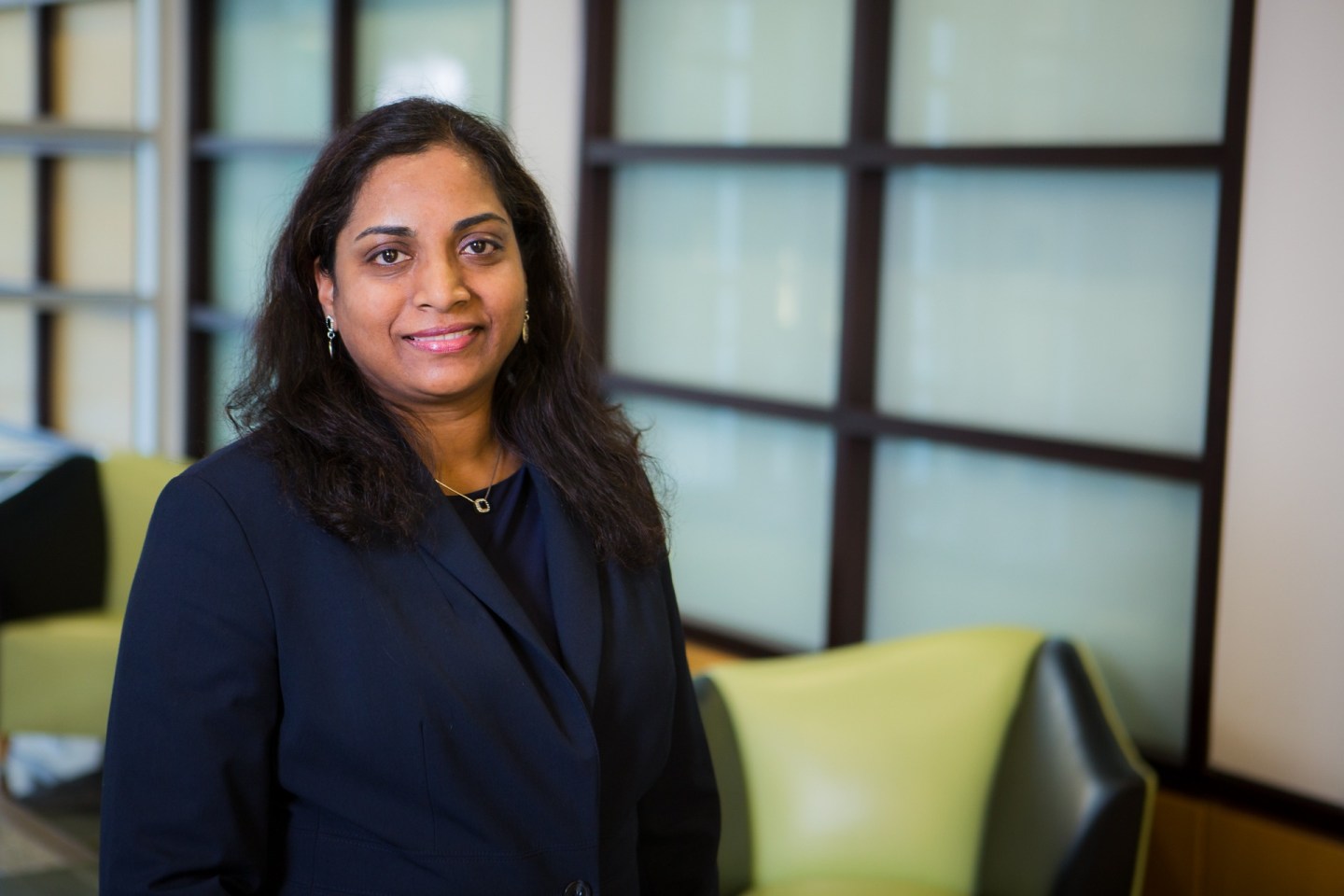
She said she approached the transition with curiosity rather than seeing it as a limitation, treating leadership as something that requires continuous growth regardless of title.
That mindset carried into scaling the company. “It’s hard. First, you have to survive,” Mathew said.
She said building the right team, not just the right product, has been central to TalTeam’s growth. “Hiring for culture is a huge part of building a successful organization.”
That growth includes real traction with federal clients: TalTeam, founded in 2011 and based in Herndon, recently won a prime technology services contract with the Federal Reserve Board of Governors, adding to a federal client roster spanning multiple agencies.
Finding confidence beyond the “quiet leader” narrative
As one of the youngest leaders on the panel, Anisha Agrawal offered a different vantage point: growing into leadership while frequently being the youngest person in the room.
As a director at Aurrera Health Group, she leads a diverse team in supporting state Medicaid agencies with implementation of high-impact, large-scale behavioral health initiatives. Agarwal, whose portfolio includes federal block grants, 988 suicide/crisis lifeline, and opioid settlement funds, said her career has been anchored by purpose. She leads with curiosity and transparency, she said, particularly while navigating uncertainty tied to federal policy shifts.
“I don’t have all the answers right now, but you can trust that I will come to you when I can share more,” Agrawal said.

She also described a narrative she had to unlearn: the belief that being introverted or quiet meant she wasn’t a natural leader. For years, she saw herself as someone more comfortable listening and observing than commanding a room, until a mentor pointed out that those same qualities were leadership strengths in their own right.
Leadership isn’t about fitting a single personality type, said Agrawal, who is an alumnus of University of Washington, Seattle. Whether someone is outspoken or reflective, she said, effective leadership comes down to authenticity, self-awareness, and the ability to connect with others, along with having mentors and allies willing to challenge her thinking.
Discussion on bias
During an open-floor discussion, Dr Shankar Rachakonda asked the panelists directly whether they had been rejected specifically for being women.
Shah said she believes collaboration across gender and background is more productive than framing leadership in gendered terms.
Mathew added, “It is not always easy. I have experienced moments where I’ve had to work harder to achieve the same outcomes. I’m not saying I feel disregarded, and I’m not blaming anyone, but sometimes things simply come more easily to certain people.”
Agrawal pointed to a related dynamic tied to age, describing the experience of frequently being underestimated as the youngest person in the room.
Arvind said the bias, even when unspoken, is well documented. “When women leaders make bold decisions or lead with strong conviction, those same qualities are sometimes labeled as aggression,” she said. “If a man demonstrated the exact same leadership style, it might be described as confidence or strong leadership.”

Driestie Kafle, an attendee from Rockville who holds certifications in risk management and systems management, spoke from the audience about building her own career independently, moving from Nepal to South Korea and later to the United States without what she called male allies.
“I show up on my own, and I solve challenges on my own,” Kafle said.
A region’s leaders, still writing the blueprint
The evening closed with remarks on the throughline that had run beneath nearly every story shared that night: empathy, in how each panelist described building trust, leading teams, and navigating uncertainty, even in moments when the word itself went unsaid.
There was no single blueprint offered by the end of the night. Shah’s ran through grief and an unplanned transition into business. Mathew’s ran through quiet reinvention, discovering new paths, and a stack of certifications. Agrawal ran through learning to trust her own voice in rooms where she was, more often than not, the youngest person present.
What tied the evening together wasn’t a formula, but a shared insistence that leadership can be learned, rebuilt, redefined and pivot on each woman’s own terms.
Lead image: (L-R) Aparna Arvind, CEO of Christopher Leah Consulting; Anisha Agrawal, director at Aurrera Health Group; CEO and chairwoman of CTIS; Dr Shankar Rachakonda, chairman of IAICC – US and Mid-Atlantic Region and CEO of Radiant Digital; and Sudha Mathew, CEO of TalTeam.
Discover more from eShe
Subscribe to get the latest posts sent to your email.
0 comments on “South Asian women leaders creating new paths to success in Greater Washington DC Area”