


“We are literally in the Star Trek age right now,” states Chaitra Vedullapalli, cofounder of community-led economic development organization Women in Cloud. The age of artificial intelligence (AI), she says, demands you to lead with risk, conviction and confidence. “Unfortunately,” she rues, due to systemic barriers in the tech industry, “women as a community are risk-averse.”
That is why Women in Cloud has set out to generate a billion dollars in new net economic access for women entrepreneurs and tech professionals by 2030, including upskilling and developing networks. Six years since their launch, they’re over halfway there, with US $600 million in economic opportunities supporting over 120,000 individuals in 80+ countries.
Though the Seattle-based tech entrepreneur views AI as an equalizer – a tool that can provide the intelligence and labor that women often struggle to access due to financial constraints – she is also mindful of the biases inherent in technology and the concentration of power in the hands of a few.
“Intelligence is in the infrastructure. Labor’s value has stalled because if labor doesn’t know how to use this intelligence, they cannot grow. The question is, who gets access to that intelligence, who owns it, and who owns the economic power to use this intelligence in the right way?” she posits, indicating that the race toward agentic AI has far more implications than many of us may imagine.
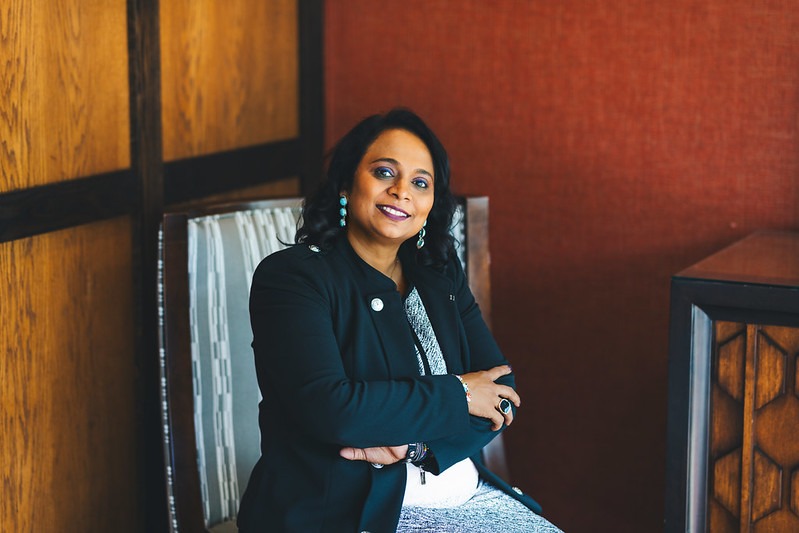
Vedullapalli, who also cofounded and runs a technology company Meylah with her husband, has recently been presenting on “human-in-the-loop governance” for regulated markets, emphasizing that while AI will decouple intelligence from labor, it must be governed by human ethics. Her work with the United Nations and her focus on digital transformation for women are aimed at ensuring that the future is not just automated, but inclusive.
Belonging everywhere
Born in Kunigal, near Bengaluru, as the daughter of an army officer, Vedullapalli was raised across the country, moving from the mist-covered hills of Darjeeling to the humid bustle of Chennai, from the military outposts of Udhampur to the industrial pulse of Mumbai.
This transient life gifted her a unique vantage point – the ability to see humanity without the fog of “systematic bias”, she shares over our Zoom conversation.
Yet, it also left her with a curious sense of displacement. “When I go to the South, they think I’m a North Indian,” says Vedullapalli. “When I go to the North, they say I’m a South Indian. I come to the US, they say you’re an immigrant [from India], and I come to India, they say you’re an emigrant [to the US].”
It is perhaps this very lack of a fixed “anchor” that allowed Chaitra to build a world of her own – one where she is not just an immigrant or a tech executive, but an “architect of billion-dollar growth”.
The leap into the unknown
Chaitra’s journey to the United States was a classic Indian narrative with a cinematic twist. At 22, she had an arranged marriage, meeting her husband for just one hour before marrying him eight days later. A month later, she flew to America alone, landing at the airport and realizing she couldn’t even recognize the man who was now her husband.
In those early days in 1995, she was a housewife trying to decode a foreign culture through the surreal lens of American talk shows like Jerry Springer. But it was another face on the television screen that would change her life: Bill Gates. Watching him talk about Windows 95 and his vision to touch a billion people with a single CD, Chaitra’s curiosity was piqued.
As an electrical engineering graduate from RV College of Engineering in Bengaluru, she understood the mechanics of generating power, but Gates was talking about a different kind of energy: digital transformation. “I’m like, that’s like the size of India,” she recalls. “How can that CD touch a billion people? Even electricity has not touched [them].”
That curiosity propelled her into the corporate world. She taught herself Oracle databases, Excel and Word, eventually landing a role at Oracle as one of the youngest directors, working in the global office for icons like Larry Ellison and Safra Catz.
Later, at Microsoft, she took on global partnerships, building the very infrastructure for go-to-market distribution that she once marvelled at on a TV screen.
The perfect tornado
Success in the corporate world, however, often comes with a hidden tax. For Vedullapalli, a mother of two, the climb up the chain meant higher intensity and higher stakes, coinciding with what she calls the “perfect tornado”: the period in a woman’s life where parents grow old, children need more time, and menopause begins to nag at the edges.
The catalyst for her departure from the corporate gilded cage was both personal and professional. Her mother needed her, and a “bad manager” granted her a “great opportunity” to see her own misalignment in the corporate world.
“I didn’t want to work for somebody who didn’t inspire me every day, who told me I have reached my ceiling and didn’t care about my contribution,” she recalls. She soon resigned, choosing flexibility and family over the senior directorship. “I didn’t want to be just a cog in the wheel.”
Rather than seeing it just as a career change, she understood intuitively that the future lay on the other side of the corporate fence. Entrepreneurship offered her the leverage to not just work hard, but to work with a “moonshot” vision in mind.

A billion-dollar mission
That moonshot took the form of Women in Cloud (WIC). She recognized that while women are fast to adopt technology, they are often stalled in their growth due to a lack of access to funding, distribution and the “political skills” or “land-grab strategies” required to navigate the upper echelons of business.
“They say it’s a woman thing and a man thing. I don’t believe that. It’s really the language and the skills to grow a portfolio, create new innovation, build a new team, and take risks to get there. I don’t think we’ve been taught all that stuff… there’s definitely a glass ceiling there,” she avers.
Several accolades, awards and talks later, through WIC and her own go-to-market framework – what she calls the 4P Cosell GTM Method – she has empowered hundreds of founders to scale their businesses through tech giants like Microsoft and Oracle. She sees her work as building “economic pathways” – structured access that gets women not just a seat at the table but allies and ambassadors in the room as well.
Her latest initiative, the FoundHer World campaign, is another step toward galvanizing communities to ensure women aren’t just participants in the digital age, but its architects. “It’s not about how good the technology is, it’s really who controls the access to the opportunity,” she explains. “Women have to be at the table to participate in those opportunities.”
From the cloud to the silver screen
Perhaps the most surprising chapter in Vedullapalli’s story is her foray into filmmaking. “I watch films for emotional regulation – they are my way of seeing possibilities,” she explains. A chance encounter with a film producer taught her that this was an economic opportunity waiting to be tapped.
So, she now manages a film fund and has produced movies like the Oscar-qualified ICONS. For Vedullapalli, filmmaking is not a departure from tech, but a continuation of her mission to tell stories that drive prosperity.
“It’s very interesting: women in tech face the same problems as women filmmakers face – lack of access to distribution, to funding, to the right talent. Same, ditto,” she says with some passion. That’s why she applies the same rigorous “hacking” mindset to the entertainment sector that she does to the cloud.
Vedullapalli, who is part of the US delegation for W20 at the G20 Summit, is currently exploring how to make independent filmmaking profitable by hacking distribution and creating corporate partnerships – the same strategies she used to scale Women in Cloud. “By the end of this year, I’ll have a full arc of learning,” she laughs.
The South Asian context
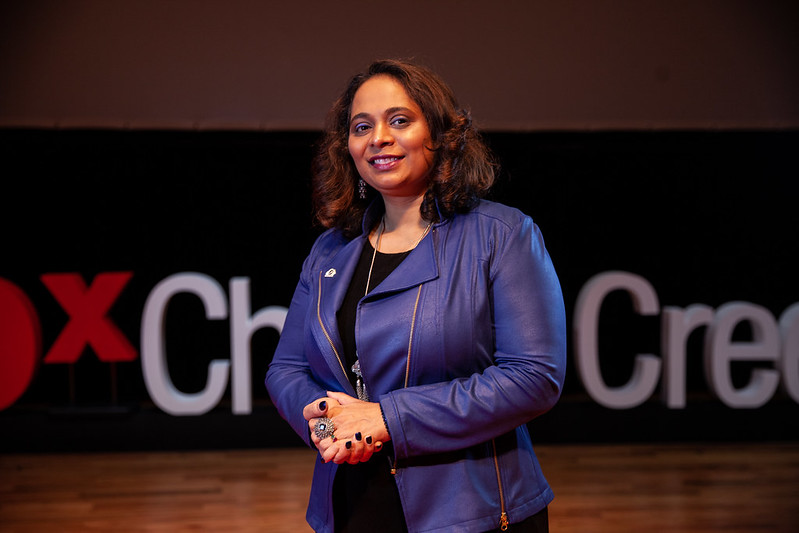
While Vedullapalli has given motivational talks on public stages such as TEDx, a private conversation with her is just as uplifting; her positive attitude and get-go spirit is contagious. “I’m a value-add person. Have I been discriminated? Absolutely, yes. But in India too, I was discriminated against – as a woman or because I had a different skin color. So it was nothing new for me, it didn’t matter. How you create value in the market is what I cared about,” she says.
Chaitra offers three key pieces of advice specifically for South Asian women. First, she says, learn about finance and financial literacy – something sorely lacking in women from this part of the world due to historical and cultural impediments. The important thing is having economic power because anything can happen anytime, and women must know how to support themselves, she says.
Second, create mastery in one or two things that only you can bring to the table. When entering any room or organization, you should be able to bring specific value because that is your mastery – your unique intellectual property or unique selling proposition. This specialized expertise becomes your calling card and differentiator, she says.
Third, be visible and authentic. Don’t be afraid to say if there’s a problem you’re dealing with, because someone is already dealing with it and can solve it for you. Be open about family crises or challenges, because “somewhere, somehow, someone will give you the answer”. Yes, there will be talk in the town – “everybody wants something to talk about”, she says referring to the South Asian obsession with societal judgment – but don’t be afraid of what people will say and don’t listen to it, she asserts. When the time of need comes, nobody will show up except the “real people”.
Looking back, Vedullapalli believes she took the right decisions at the right time: if she had continued in her corporate roles, she would have been just “a cog in the wheel”. Now, she says, “I walk into any room with my confidence cape on, there to contribute to every society in the right way.”
Discover more from eShe
Subscribe to get the latest posts sent to your email.
0 comments on “On a $1 billion quest with a “confidence cape”: Seattle tech entrepreneur Chaitra Vedullapalli”