
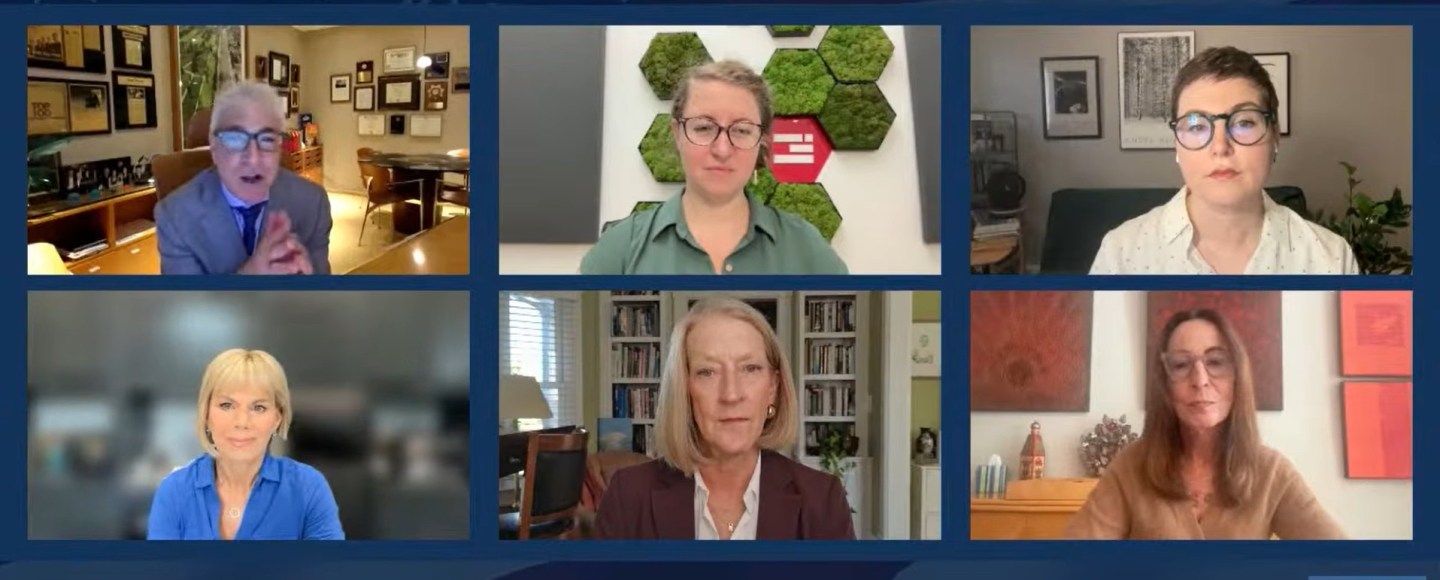

The disproportionate targeting of women journalists, their safety at work, press freedom, access restrictions, legal pressure and declining trust in news media were among the key issues raised at an online forum organized by Speak Up for Justice on 17 September.
The discussion was framed not simply around the relationship between governments and the press, but around what happens when women journalists face hostility because they are women asking questions of powerful people.
For women journalists, the risks extend beyond professional disagreement: personal attacks, misogynistic language and threats can affect whether women feel safe doing their jobs and whether other journalists are willing to challenge those in power.
Gretchen Carlson, journalist, author and co-founder of the nonprofit Lift Our Voices, said women reporters should not be left to face such treatment alone.
“When a female journalist asks just a regular question, and she gets a reaction from President Trump like that,” Carlson said, “the next journalist’s question should be the same question.”
Mary McCord, executive director of the Institute for Constitutional Advocacy and Protection (ICAP), supported the suggestion. “I like the idea of journalists coming to the support of the woman who got attacked and saying, ‘We’re just going to keep asking you that same question, President, until you answer it’,” she said.
At the same time, the pressure created by this dynamic was acknowledged as particularly difficult because journalists also depend on access to powerful institutions. Lawsuits and the possibility of losing access were identified as factors that can make reporters hesitate before challenging officials.
The gendered nature of these confrontations was emphasized by Elisa Lees Muñoz, president of the International Women’s Media Foundation (IWMF). She said women journalists were being singled out “mostly, almost exclusively” for personal attacks in press rooms.
“Using misogynistic terminology to attack women journalists is a tactic,” Muñoz said. “It’s an attack against press freedom.”
That distinction matters because sexist abuse can make a journalist’s gender part of the story when her reporting should be the focus. At the forum, speakers suggested that coverage of attacks on women reporters should look beyond the individual confrontation and examine the language and tactics being used against them.
Paul R. Kiesel, trial attorney and founder of Speak Up for Justice, said journalists should collectively make clear that misogynistic treatment of women reporters by the administration is unacceptable.
The need for such solidarity was underscored by a broader discussion of pressure on journalism. Investigations, lawsuits, restrictions on access and regulatory pressure were cited as different forms of pressure that can influence how news organizations operate. The concern raised was not that every government interaction with the media is improper, but that repeated pressure can make journalists more cautious about pursuing difficult stories.
The discussion comes days after President Donald Trump called CNN reporter Kristen Holmes “disrespectful” and a “fake reporter”. The White House’s ‘Rapid Response’ X account later criticized her for asking a “disgusting and inhumane question” that her children would be “sickened and embarrassed” by.
McCord said she believed such efforts during the second Trump administration could chill the press. She cited examples such as FBI investigations of journalists, defamation lawsuits, pressure involving media organizations and restrictions concerning press access.
President Donald Trump announced today that he has banned three news outlets – CNN, MS NOW and Politico – from the White House for their “negative stories”.
The effects of such pressure are significant when journalists begin to alter their own behavior.
That dilemma was described by Quinta Jurecic, staff writer at The Atlantic, who noted that access to people in power is an important part of reporting. But the dependence on access can leave journalists having to weigh professional independence against the possibility of losing an important source of information.
The same tension was identified in discussions about self-censorship. McCord said that when journalists restrain themselves because of concerns about lawsuits, subpoenas or investigations, citizens ultimately receive less information.
The consequences, therefore, extend beyond newsrooms. “Robust debate on issues of public policy is stifled, and then civic participation in democracy, voting, petitioning the government, exercising the right to protest, all of these things suffer,” McCord said.
Stephanie Sugars, managing reporter at the U.S. Press Freedom Tracker, described the scale of the challenge facing journalists as an “overwhelming flood” of incidents. The organization, she said, has had to change how it records chilling behavior because statements are occurring “too frequently for us to reasonably count each one individually”.
The safety concerns become even more tangible for women reporters working in hostile environments. Muñoz recalled journalists being targeted at political rallies and later being attacked while traveling to their cars or working at venues.
Safety planning has consequently become part of ordinary journalism for some reporters. The IWMF provides training on practical precautions, including how journalists park their cars so they can leave quickly if necessary.
For local journalists, the risks can be particularly acute. Reporters covering protests or immigration enforcement operations may be well known within their communities, making it easier for hostile individuals to identify where they work or live.
The scale of the resources now required was captured in one striking statistic: Muñoz said that almost 90 per cent of the IWMF’s work is currently in the United States, helping journalists stay safe.
For an organization that has spent 35 years supporting women journalists globally, she described the shift as significant. It indicates how safety concerns have expanded even within a country with longstanding press-freedom protections.
The forum also highlighted an important feminist dimension to safety: women journalists are often required to negotiate risks that are simultaneously professional and personal. The threat is not simply that a story might be criticized. A woman reporter can face attacks directed at her identity, appearance or gender, making the consequences of doing her job more intimate.
“The message is that misogyny lives,” said Carlson. “The message to our young men is that you can treat women like that. The message is there are no penalties if you treat women like that. The message is women don’t belong in these high places.”
At the same time, journalists were described as finding new ways to continue reporting. Sugars said reporters were developing creative methods to obtain information despite restrictions and declining trust in the media.
Carlson pointed to reporting from inside the Pentagon as an example. Although she said regular Pentagon reporters had faced restrictions on access, she also observed that journalists had responded by finding alternative ways to investigate and report stories: “I think it’s actually invigorated them to dig deeper for some of these stories.”
The discussion also connected the treatment of journalists to the public’s relationship with news. Muñoz argued that attacks on the media become easier to sustain when public trust in journalism has already weakened. “If we were in a situation where the public valued the news media, I don’t think it would be as easy to make these attacks stick,” she said.
Sugars highlighted the disappearance of local newspapers and the growth of “news deserts” as another reason for declining trust. Local journalism, she said, can provide information that people can independently compare with their own experiences. “And so, as that has been disappearing, that foundational trust is just not being built,” she stated.
Carlson linked the broader fragmentation of the media environment to the rise of cable news and later digital platforms, where audiences can increasingly choose information that reflects their existing views. “We are so divided in this country, and the news information that people are receiving is nothing that they don’t want to hear, and so that division just grows more and more,” she said.
Yet the forum’s central message remained that journalism requires space for women to question power without being punished for their gender.
Sugars asserted that, as the “fourth estate”, the press is a check on power that can contribute to better governance. Kiesel added: “Every country where democracy has collapsed into authoritarian rule in the last 20 years has followed a typical sequence. They come after the courts, they come after the attorneys, and they come after the media.” McCord similarly argued that a free press is necessary for citizens to remain informed and participate in public life.
For women journalists, that freedom has an additional dimension. When misogyny is used to discredit a reporter rather than answer her question, the issue is no longer simply about press-room etiquette. It becomes a question of whose voice is permitted to challenge power – and whether women can do so without being made to pay a higher price.
Watch the full discussion on YouTube.
Discover more from eShe
Subscribe to get the latest posts sent to your email.
0 comments on “Women journalists face rising personal attacks as press freedom debate intensifies in DC”