
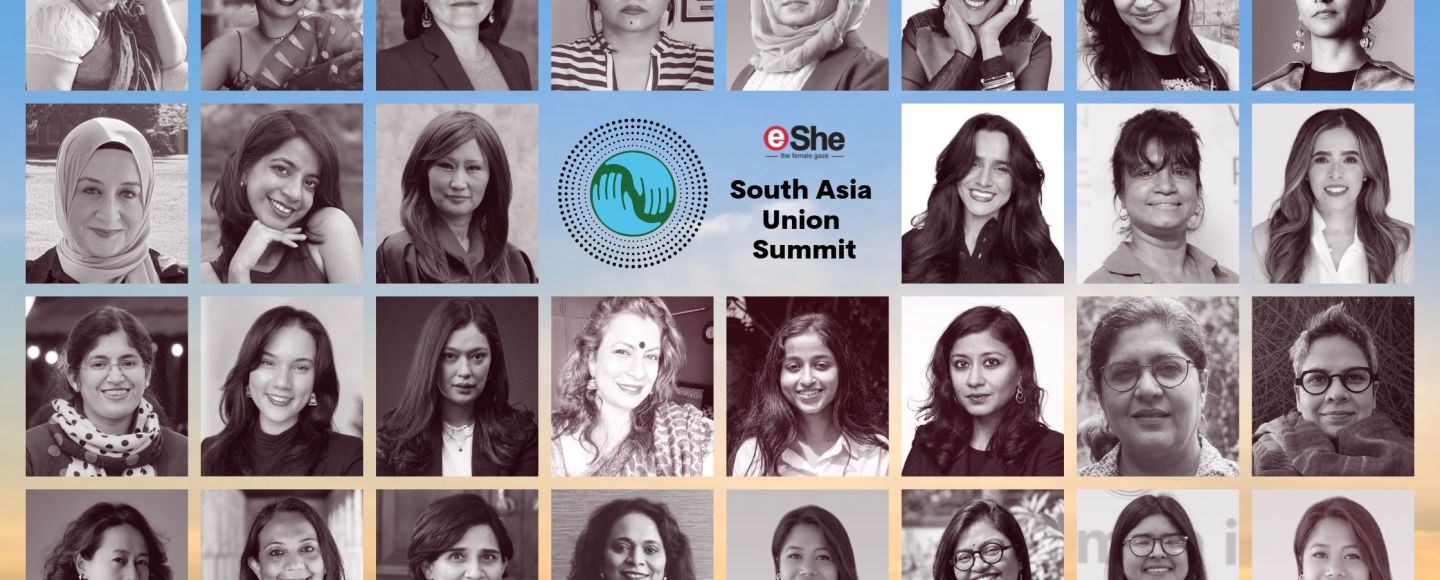

What does it take to imagine a South Asia where borders do not dictate solidarity, technology does not reproduce existing inequality, and women, minorities and indigenous peoples are not expected to bear the costs of political power, social prejudice and economic progress?
These are among the urgent questions at the heart of the South Asia Union Summit 2026, eShe’s flagship, women-led gathering returning virtually from November 13–15 under the theme Gender, Power, Resistance.
Bringing together activists, journalists, filmmakers, technologists, cultural practitioners, and young changemakers from South Asia and its global diaspora, the three-day Summit will examine the forces shaping women’s lives and the possibilities for collective action across national boundaries.
At a moment when democratic freedoms, women’s safety, climate justice and independent journalism face mounting pressures, the Summit offers more than a platform for discussion. It invites participants to question entrenched power structures, challenge familiar narratives and imagine more equitable futures together.
Beyond borders: Feminism as a shared political project
South Asia’s histories are deeply interconnected, even as contemporary politics often emphasizes divisions of nationality, religion, caste, ethnicity and identity. The Summit’s premise is that meaningful change requires conversations that cross these boundaries rather than reinforce them.
For eShe, an independent, women-led newsroom based in Seattle, with operations in Washington, DC, and volunteers in North America and India, this cross-border approach is central to its work documenting the lived experiences and political realities of South Asian women and gender-diverse communities.
The second edition of the South Asia Union Summit builds on the inaugural gathering, which brought together 50 women from 13 countries to discuss peace, gender equality, and social justice.
This year’s program expands the conversation to include artificial intelligence, media censorship, women-led political movements, bodily autonomy, climate change and the relationship between caste and patriarchy.
The event is free to attend, with sessions streamed live on Zoom and broadcast on Facebook. One registration covers all three days, making it possible for participants across continents to join the conversations.
Keynote speakers for each day include Bhutanese politician, author and diplomat Lily Wangchuk and multi-award-winning Maldivian governance leader and feminist icon Dr Aishath Rafiyya.
Who belongs? Nationalism, technology, and the politics of exclusion
The summit opens on November 13 with a question that resonates across democracies: Who counts as “us”?
Panelists, including Indian YouTuber and historian Dr Ruchika Sharma, Pakistani minority rights activist Jayya Jaggi, Bangladeshi academic Dr Marufa Akter, and Hurunnessa Fariad, a former child refugee from Afghanistan now an activist in Virginia, USA, will participate in a discussion examining nationalism, migration and minority rights.
The conversation will explore how majoritarian politics, state power, legal frameworks and digital technologies can marginalize vulnerable demographics and dissenting voices. At stake is not merely the definition of national belonging, but the meaning of pluralism in societies where difference is increasingly politicized.
The day’s second panel turns to artificial intelligence and systemic bias. Tech entrepreneur and founder-president of the collective Women in Cloud, Chaitra Vedullapalli from Seattle and Shreya Krishnan, managing director of AnitaB.org India from Bengaluru, among others, will join a conversation about who builds technological systems, who benefits from them and who bears their costs.
As AI becomes embedded in hiring, healthcare, education, public services and everyday communication, its apparent neutrality deserves scrutiny. Algorithms can reproduce inequalities related to gender, caste, class, and race when the systems behind them reflect existing prejudices.
A feminist approach to technology asks a fundamental question: Can innovation be considered progress if it leaves entrenched power untouched?
Who controls the story? Women reclaiming cinema and journalism
On November 14, the focus shifts to cultural representation and the power of storytelling.
South Asian cinema has long shaped public perceptions of womanhood, often positioning women as objects of desire, symbols of sacrifice, or victims of violence. Award-winning filmmakers Shazia Iqbal from India, Anam Abbas from Pakistan, and Sulochana Peiris from Sri Lanka with share the stage with Sikkim-based film director Tribeny Rai, as US-based film studies professor and filmmaker Sonali Gulati moderates a panel to explore what changes when women take control of the camera and the narrative.
Their session, From Object to Author: When Women Control the Frame in Cinema, will examine authorship, representation and the challenge of dismantling patriarchal hierarchies in filmmaking.
The question extends beyond who appears on screen. Who decides which stories are worth telling? Whose experiences are considered universal, and whose remain at the margins? When women and gender-diverse creators shape their own narratives, cinema can become a space for resistance as well as artistic expression.
The next conversation, Truth Under Fire: Media Censorship and Propaganda Press, examines the pressures confronting independent journalism.
Anuradha Bhasin, managing editor of Kashmir Times, joins Zahra Nader, founding editor-in-chief of Zan Times, an award-winning Afghan women-led newsroom, and award-winning international correspondent Niha Masih in a panel moderated by author-filmmaker Natasha Badhwar that will address censorship, state pressure, propaganda, internet shutdowns and legal harassment.
When journalism is silenced, the consequences extend beyond newsrooms. Communities lose access to information, abuses become harder to document, and public debate narrows. The session will consider how independent reporting, alternative platforms, and cross-border solidarity can help keep the truth in circulation.
For a women-led newsroom like eShe, these questions are inseparable from the struggle for gender justice: those whose voices are already marginalized often face the greatest barriers to being heard.
The body as a site of power and resistance
The November 14 program also confronts the politics of bodily autonomy.
UK and Kenya-based writer, lawyer and activist Farah Ahamed, filmmaker and feminist artist Paromita Vohra from India, and Pakistani-American gynecologist Dr. Sameena Rahman will participate in Body as Battleground: Gender, Sexuality, Culture and Resistance, a discussion of how cultural expectations, religious authority, and state power shape women’s and queer people’s bodies. wellbeing and lives.
From the policing of clothing and intimacy to the regulation of sexuality and identity, control over bodies is frequently presented as a matter of tradition or morality. Yet these restrictions raise fundamental questions about freedom, dignity, health and equal citizenship.
By examining these questions across South Asian and Western contexts, the panel will challenge the assumption that gender-based control belongs to any one culture or political system.
Young women, democracy and the climate crisis
On November 15, the summit turns toward political transformation and the meaning of progress.
Bangladeshi community organiser and activist Trishia Nashtaran will moderate a panel of young political activists at the forefront of the Gen-Z uprisings in South Asia – Tanuja Pandey from Nepal, and Umama Fatema from Bangladesh, among others – in the panel The Future of Democracy: Gen Z, Women and Political Activism.
The session will examine how women, particularly younger activists, are challenging authoritarian leadership, divisive rhetoric and political violence. Recent Gen Z movements across South Asia have demonstrated the capacity of young people to reshape political debate and demand accountability.
The next conversation asks a related question: who defines ‘progress’ and who pays the price?
In Who Pays for Progress? Climate Change, Gender and Neocolonialism, climate activists such as Manshi Asher will explore the unequal distribution of power and costs in the global climate transition.
Climate finance, resource extraction and development cannot be separated from questions of gender and economic justice. Women and indigenous communities often bear the brunt of environmental degradation while having limited influence over the decisions that shape their futures.
The discussion will consider what climate action could look like if it were more locally led, accountable and equitable.
Digital feminism and the unfinished struggle against caste
The final day’s conversations also examine the changing terrain of feminist activism.
Influencers and ‘Insta-feminists’ Muskaan Madaan, Sofia Shah and Priya Sigdel, among others, will participate in Gender Activism 4.0: Influencers, Cyberfeminism and Digital Cultures.
Social media has created new opportunities to organize campaigns, circulate feminist ideas, and reach audiences beyond traditional institutions. Yet online visibility comes with its own power dynamics: algorithms determine reach, monetization can influence messaging, and harassment and surveillance can push activists into silence.
The panel will examine how feminist movements can use digital platforms strategically without overlooking the inequalities embedded within them.
The Summit concludes its scheduled panel discussions with a subject that remains central to South Asia’s struggle for equality: the intersection of caste and gender.
In Patriarchy, ‘Purity’ and Power: Breaking the Chains of Caste and Gender, acclaimed author-activist Christina Dhanuja from New York and cofounder of the Dalit Lives Matter movement Bridhika Senchury from Nepal, among other speakers, will be in discussion with moderator Shailee Chaudhary, human-rights lawyer and Australia Award Scholar, to examine how caste hierarchies and patriarchal expectations reinforce each other.
The session will focus on the disproportionate burdens and violence faced by Dalit and other marginalized women, as well as the roles of families, religious institutions and the state in sustaining exclusion.
It will also consider pathways to change, including organized resistance, effective legal reform and everyday acts that reject the idea that caste and gender should determine a person’s future.
Join the conversation
eShe South Asia Union Summit 2026 addresses some of the most consequential questions of our time. Its ambition is not simply to call out injustice, but to create space for the exchange of ideas, experiences and strategies that can inform collective action.
For anyone invested in women’s rights, democratic freedoms, climate justice, media independence, or the future of South Asia, the summit offers an opportunity to listen across borders and engage with perspectives that too often remain separated by geography and politics.
Participation is free, and a single registration provides access to all three days of programming.
Read more and register at eshe.in/summit-2026.
The future of South Asia will not be shaped by governments and institutions alone. It will also be shaped by the people who question power, refuse silence, and build solidarities across differences. This November, the invitation is to be part of that conversation.
Free to attend.
Made possible by you.
We keep the Summit free so that anyone, anywhere, can join the conversation. Your gift supports independent, women-led journalism and keeps platforms like this open to everyone.
Discover more from eShe
Subscribe to get the latest posts sent to your email.
0 comments on “eShe South Asia Union Summit 2026: gender, power, resistance”