
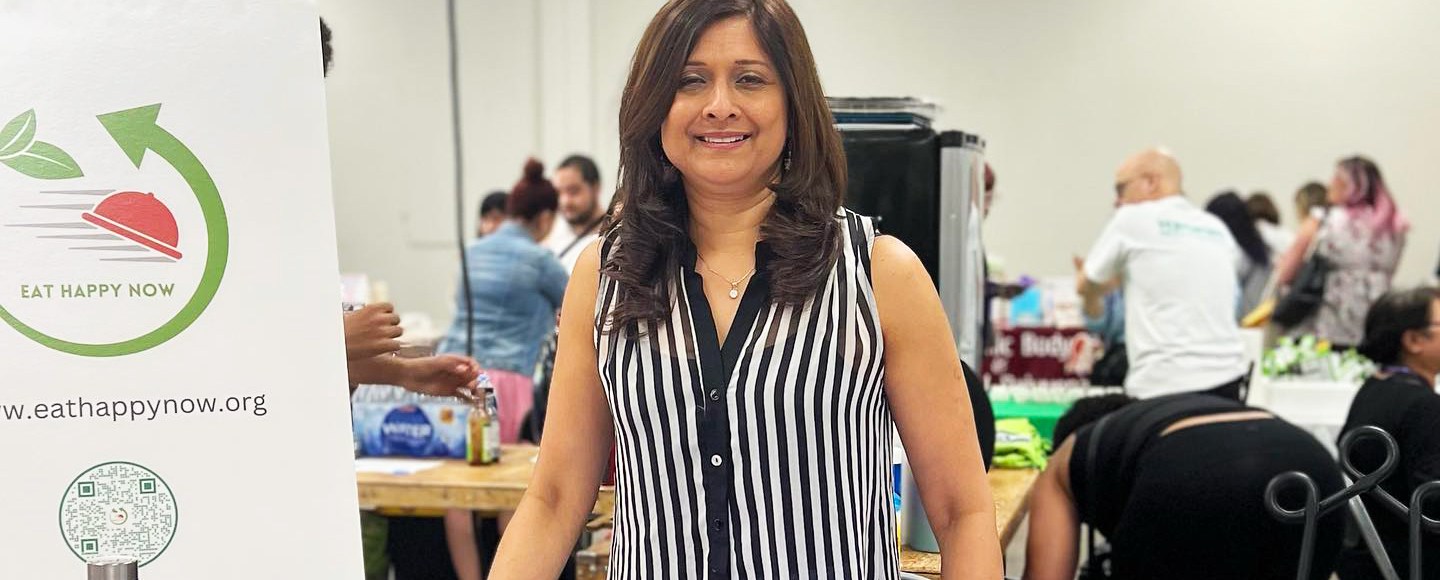

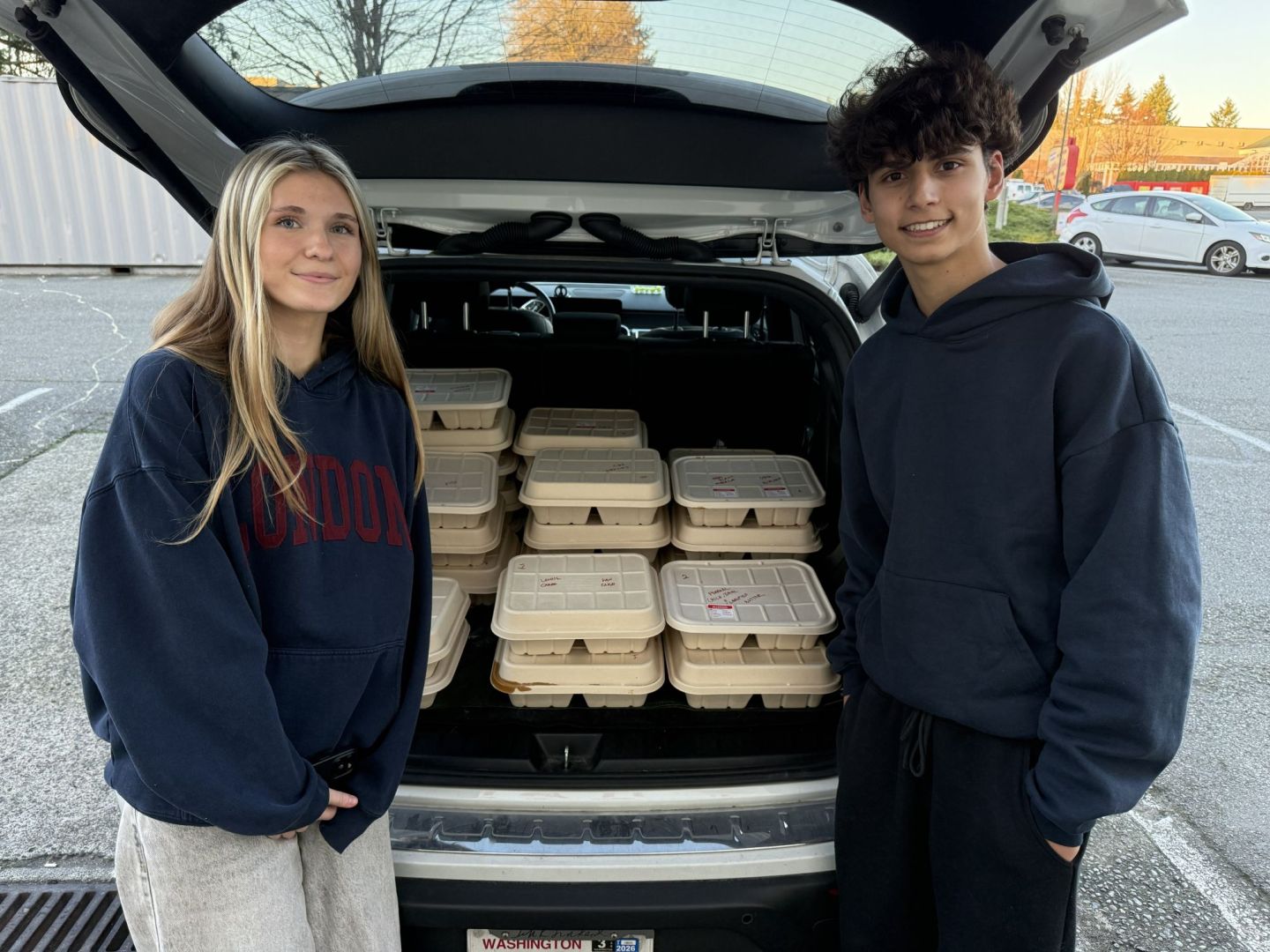
SEATTLE, WA: On a typical day, 15 to 20 food pickups happen across King, Pierce and Snohomish counties in Seattle metropolitan area. Using an app, volunteer drivers collect surplus food from restaurants, ethnic grocery stores, school cafeterias and corporate kitchens and deliver it to low-income housing complexes, youth and adult shelters, and community food banks.
The app is part of Eat Happy Now, a Bellevue-based nonprofit that says it has rescued more than 1.3 million pounds of food in less than four years. That volume, the organization says, has also kept an estimated 3.5 million pounds of CO2-equivalent emissions out of the atmosphere, since decomposing food in landfills produces methane, a gas more potent than carbon dioxide.
The nonprofit has one full-time staff member, eight part-time staff, and a volunteer base of about 800, now reaching more than 55,000 recipients a month across the Seattle area.
Seeing the problem
Founder and CEO Sharmila Rathinam didn’t come from the food or logistics world. A chartered accountant by training, her 25-year career began with roles at Arthur Andersen and Ernst & Young in India. After she and her husband moved to the Seattle area in 1999, she worked in financial planning and later in business management at Microsoft.
She is one of a small number of South Asian women running a tech-enabled nonprofit at this scale in the region, a fact she rarely leads with, but one that shapes the organization she built.

But something about life in the United States had troubled her ever since she landed here.
“The first thing that hit me was the sheer amount of food that is being produced,” Rathinam tells eShe. “I saw so much food being wasted.”
Almost 40 percent of the entire US food supply goes to waste each year. Rathinam noticed it in restaurants and around grocery stores. The contrast was particularly striking because she grew up in India. “We grew up with this very, very basic principle that no food should be wasted,” she says. “You eat everything on your plate.”
Along with the abundance and wastage in the US, she also encountered people struggling to afford three meals a day and began paying closer attention to food insecurity around her. It surprised her most when she found it close to home: families with steady jobs just one setback away from not being able to eat – a missed shift, an illness that insurance didn’t fully cover.
What she found challenged her assumptions about Seattle’s Eastside. “I didn’t realize there was so much hunger in affluent neighborhoods,” she says.
Then, within about two miles of her Bellevue home, she discovered shelters and food banks she had barely noticed before. What troubled Rathinam was the contradiction: people were struggling to eat while usable food was being discarded nearby.

She began to see the problem not only as one of hunger or food waste, but also as a logistics problem: how to move surplus food from where it existed to where it was needed.
“There is enough food being wasted today to feed so many,” she states.
About seven or eight years ago, Rathinam left Microsoft because, as she puts it, “the promotions and the paychecks did not define what I wanted to do.”
During a 10-day Vipassana silent meditation retreat, she says, the two issues that had troubled her for years – food waste and hunger – came together. She wanted to close the gap: not by producing more food, but by finding a faster way to move food that already existed to people who could use it.
When she returned, she began researching food waste and the local food-assistance system, and the seeds for her nonprofit Eat Happy Now were sown.
Building the connection
Rathinam noticed a pattern: smaller food banks often lacked the resources to collect surplus food themselves, while larger food-rescue organizations tended to focus on bigger donations. That left smaller sources of surplus food with fewer options for getting usable food into the charitable food system.
She also noticed another gap: culturally relevant food. Indian, Mexican, Asian and European grocery stores carried produce and ingredients familiar to many immigrant communities, Rathinam says, but some were too small to attract larger food-rescue operations.
Her nonprofit Eat Happy Now began focusing on these gaps. Currently, the nonprofit does not have the capacity to match donations to recipients based on ethnicity. Even so, rescuing food from ethnic grocers adds foods that some shelter recipients may recognize from their own cultures to the broader mix of donations.

Restaurants, cafes and bakeries presented a different problem: time. Perishable food could still be usable, but it needed somewhere to go quickly. Rathinam described it as a “food logistics connection problem.”
Eat Happy Now addressed these issues by keeping pickups local, generally within five to eight miles and in or near the same city or ZIP code. Rathinam says the nonprofit aims to get rescued food to its destination within 45 minutes.
She compares the model to “an Uber Eats for any surplus food in the ecosystem.”
Community participation is built into the model. Rathinam says about 70 percent of pickups are handled by volunteers, allowing residents to become part of the solution rather than simply donating to it. When volunteers cannot cover a pickup, Eat Happy Now can also turn to third-party delivery platforms like DoorDash.

But the technology does more than put drivers on the road. Every rescue generates information: who picked up the food, how much was collected and where it was delivered. As the operation grew, so did the amount of data.
“How are we going to make sense of all the numbers we are collecting?” Rathinam asked herself.
Using data to keep the community informed
For Rathinam, the answer was not simply about managing the operation. It was also about transparency and being able to show volunteers, donors, funders and the wider community what was happening to the food they helped rescue.
And so, Eat Happy Now began using what Rathinam describes as an AI-enabled analytics dashboard to analyze its operational data and generate impact reports. Information recorded through the app also feeds the organization’s real-time impact tracking, allowing it to report how much food has been rescued and the resulting impact.
The technology helps make the work visible. But the work itself remains deeply human: businesses have to offer the food, recipient organizations have to be able to use it, and someone still has to make the trip.

That dependence on participation comes with its own challenges. Eat Happy Now’s funding is split roughly evenly between individual community donors, local foundations, city grants, and a newer funding stream from Washington State’s Department of Ecology. That diversification, she says, matters because any single source could disappear from one year to the next.
Businesses, meanwhile, can be hesitant to donate.
Convincing businesses to donate
Part of the resistance, Rathinam says, comes from businesses worried about liability if donated food makes someone sick. Convincing restaurants and grocery stores to donate surplus food remains one of Eat Happy Now’s biggest day-to-day challenges.
“A lot of what we do is also education and advocacy,” Rathinam says. In conversations with businesses, she points to federal protections for food donors.
For instance, The Bill Emerson Good Samaritan Food Donation Act provides liability protections for qualifying donations of apparently wholesome food made in good faith. Congress expanded those protections through the Food Donation Improvement Act, signed into law in 2023.
The protections do not mean that anything left over can simply be donated. Food-safety requirements still apply.
Eat Happy Now does not rescue food that has already been served to an individual table. But untouched catered food remaining in serving pans may be eligible for rescue when it can be handled and transported safely.
For Rathinam, knowing that distinction is important not only for nonprofits but for restaurants, grocers, caterers and other businesses deciding what to do with surplus food.
That challenge lands hardest on the smaller, often immigrant-owned businesses Rathinam has spent years trying to reach, the ethnic grocers and family restaurants least likely to know that the law protects them, and most likely to be sitting on food someone nearby actually needs.
She argues that changing the system will require businesses to see edible surplus differently – not simply as something to throw away at the end of the day, but as food that could still have another destination.
“If they don’t donate, then we don’t have a program,” Rathinam says.
The policy question
Washington has set a statewide goal of reducing food waste by 50 percent by 2030 compared with 2015 levels, including reducing at least half of edible food waste. Washington Department of Ecology estimates that the state generates more than one million tons of food waste annually, with roughly 35 percent consisting of edible food going to landfills.
The state’s Use Food Well Washington Plan puts food rescue between two other strategies: preventing food from being wasted in the first place and finding productive uses for food that cannot be eaten.

The state has adopted a series of organics-management laws alongside its food-waste reduction goals, including prevention, food rescue and recycling. Even so, Rathinam believes stronger requirements on businesses could accelerate food rescue.
She points to California’s SB 1383, which requires specified commercial edible-food generators to arrange for the recovery of the maximum amount of edible food that would otherwise be disposed of. The state also requires jurisdictions to establish edible-food recovery programs and build sufficient recovery capacity.
Rathinam would like to see Washington move further in that direction.
“If there is a law in place, I think it becomes a lot easier to stop food waste,” she says.
She hastens to add that policy is only one part of the equation. Businesses still have to participate. Food-recovery organizations need enough capacity to accept donations. Volunteers have to make pickups. And nonprofits need money to keep the network operating and keeping stakeholders connected.
Nearly four years on, in a region known for building technology capable of connecting almost anything, Eat Happy Now is still working on these connections, one pickup at a time.
Discover more from eShe
Subscribe to get the latest posts sent to your email.
0 comments on “This woman’s nonprofit is changing how Seattle thinks about hunger and food waste”