


Four years ago, Vinita Lakra’s teenage daughter (now 20) eloped with a boy. The girl told her mother that she would look for work with him outside of the district of Simdega, in the eastern India state of Jharkhand, where they lived. Vinita believed the story.
“Last November, when I finally managed to get in touch with my daughter, she told me that the boy had sold her in Rajasthan,” Vinita shares. Mother and daughter were inconsolable about the incident. Unsure whom to seek help from, Vinita approached Augustina Soreng, known for her work in women’s empowerment in her hometown of Simdega.
Within four days, Vinita had her daughter back with her.
This is just one of the many cases Augustina has helped resolve. Working with women living on the margins of the patriarchal order, she has become a source of support, advocacy and hope for Adivasi (tribal) women who often have nowhere else to turn.
In recognition of her grassroots work towards gender justice, the educator and activist was honored with the 2024 Martha Farrell Award for Women’s Empowerment and the 2024 Samya Excellence Award for Gender Champions.

Choosing her life’s path
In a district where the literacy rate is just 68 percent, with women’s literacy even lower at 59 percent (as of 2011), Augustina persevered to complete her BSc degree majoring in zoology from Simdega College, one of six higher education institutions in the district.
Sharing how her experiences and learnings shaped her life’s calling, Augustina says, “During my graduation, I was teaching in one of the schools in Simdega. I realized that because of human trafficking, a lot of children dropped out of school. The other reasons were violence in the home and parents passing away.”
The traditional schooling system did not account for these cases. Instead, it simplified children’s multifaceted identities into narrow tropes. Augustina observed that, when children who dropped out of a certain class were reintegrated back into the formal schooling system, they were not on par with their peers.
In addition to this, the teachers did not make extra efforts to help these children cope to account for the time that they had lost. When Augustina brought these issues to the notice of the authorities, her views were not appreciated. But this experience made her realize her calling.

Working for the rights of the Adivasi community
It’s been almost 12 years since Augustina has been working for women’s rights in Simdega.
The 35-year-old’s journey started with her role as a program coordinator with Adivasi Women’s Network. Today, she’s associated with the Indian School of Business (ISB), where she advocates for issues concerning Adivasi women and her Khadia community.
As ISB’s district coordinator in Jharkhand, she says she wants women from these communities to have a voice and to become capable of shaping policies and transforming their communities.
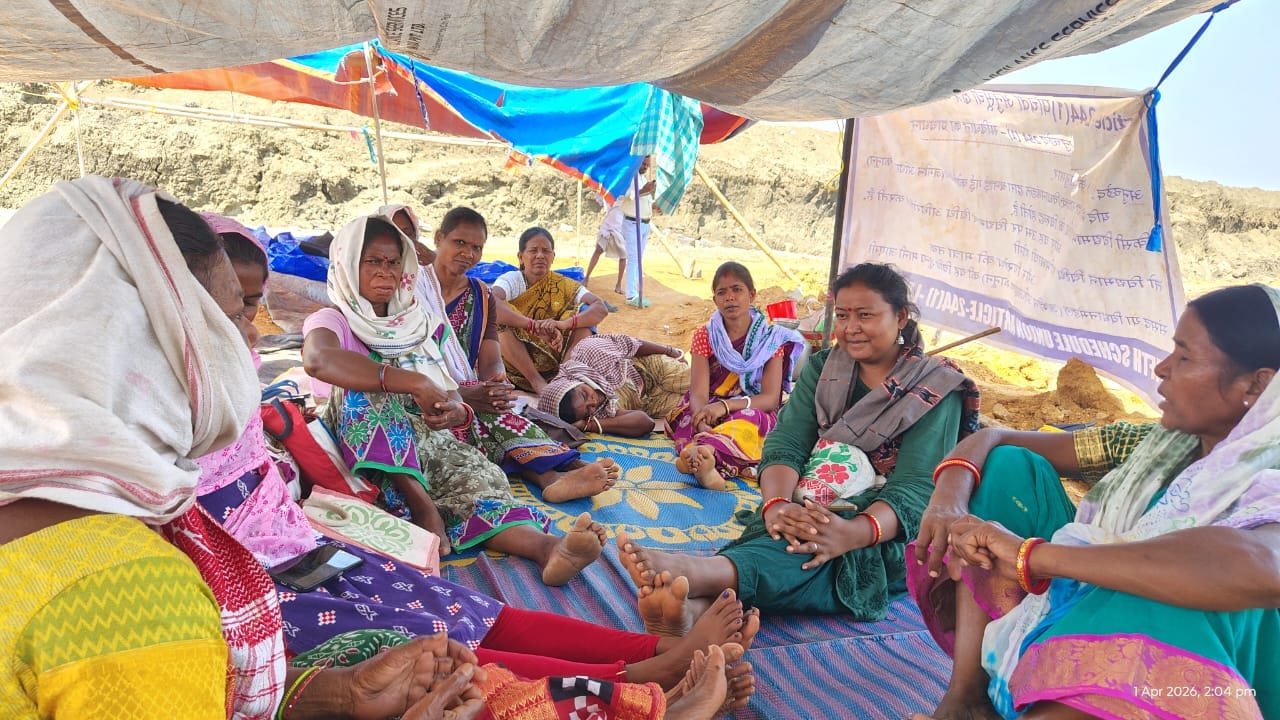
Her work does not stop at awareness. It extends to helping indigenous women confront systemic barriers from human trafficking, witch-hunting and domestic violence. In communities where the idea of women’s rights and empowerment has filtered in slowly, her work is helping women recognize their voices, understand their rights, and claim their place in shaping their own futures.
The witch-hunt
Earlier this year, reports emerged from Jharkhand about a tribal woman and her 10-month-old son being burnt to death on the suspicion of witchcraft. Four people were later arrested in the case.
According to the National Crime Records Bureau, more than 2,500 people, mostly women, were killed in India on suspicion of witchcraft between 2000 and 2016.
The murders in Jharkhand occurred in the Kudsai hamlet and were triggered by rumors of sudden cattle deaths and the death of a local. The community was unforgiving.
A paper exploring the practice of witch-hunting cites its prevalence in 12 states, including Bihar, Jharkhand and Odisha. Ostensibly rooted in beliefs around witchcraft, the practice can have devastating real-world consequences for women and their families.
As the authors state, “At times, witch-hunting survivors were made to stay 50 to 60 kilometers away from their homeland. Their family members also undergo stigma and rejection from society, which also affects the psychosocial functioning of the victims as well as their family members.”
While laws are in place to tackle this, the solution on the ground isn’t black and white. The Prevention of Witch (Daain) Practices Act, 1999, in Bihar was adopted by Jharkhand with changes in 2001. The punishment is imprisonment and/or a fine.

In addition to this, the Central Institute of Psychiatry (CIP) and Jharkhand State Livelihood Promotion Society (JSLPS) entered into a nonfinancial Memorandum of Understanding (MoU) in November 2021. The project, called GARIMA, aimed to make Jharkhand free from witch-branding and witch-hunting practices.
But even while these programs exist, many women are unsure how to access them.
Elaborating on one case, Augustina shares, “There was a woman from our Sewai village who was around 50 years old. One day, a child from the neighbor’s house took her phone and left with it. When she found her phone missing, she knew the culprit was the child, and said, ‘Uska bura hoga (Something bad will happen to the child).’ There were others around who heard her say this. Soon after, the child fell ill, and the family blamed the woman, saying that her witchcraft was responsible for the child’s illness.”
When the woman called Augustina late at night, frantic about what to do, Augustina immediately informed the police, and they reached her house the next morning. “We took the child to the hospital, where he received treatment. The police then went to the village and looked into the matter,” she says, adding that, while things are okay now, the woman is still traumatized by what happened.
Another example is Dulari Kujur, who sought Augustina’s help to file a police complaint against her sister-in-law, who had accused her of performing witchcraft and blaming her for her misfortunes.
Such instances highlight how, in a place where the social skew is against women, an activist like Augustina is often these women’s only hope.

The two Indias
The way Augustina sees it is that the country’s population is cleft into two halves. “There is a rural India where people face violence and hardship. Then there are those who have never experienced these realities, and they behave differently towards the former. I slowly started feeling that I should do something for my people. I should use my education to do something for the people who believe in jal, jungle, zameen (water, forests, land).”
In her current capacity, Augustina’s work now extends to 200 villages across Simdega.
The focal point of her efforts is to help women counter challenges like witch-hunting, human trafficking, migration and domestic violence. She continues to work on forest rights while advancing the rights of tribal women through community mobilization, advocacy and grassroots engagement.
With the help of ISB, Augustina started a platform, Sona Buru Jungle Producer Company, in 2025, which enables women to sell the produce they procure from the forests, such as sal beej (sal tree seeds) and chironji (dry fruit).
ISB helps them tap into the right markets. Augustina explains, “Ours is a forest producer company in which women are shareholders, and they send forest products to industrial buyers. So far, 28 villages have received royalties from these resources.”

As Chandrakanta Kumari, who works with Augustina, explains, the reason behind creating this platform is to help women in Simdega find work. “Many young women leave home to look for work because of the lack of employment opportunities. When they go outside in search of jobs, they can become vulnerable to trafficking and exploitation. There was one girl from Simdega who had gone abroad for work. Her employer took away her passport and documents and told her that she could not leave. She became trapped in a foreign country. With our intervention, she was eventually able to return home,” Chandrakanta shares.
Countering human trafficking
A study of 30 trafficking survivors from Jharkhand by Economic & Political Weekly found that illiteracy, unemployment, loss of a parent, and alcohol addiction in the family often drove minors and young adults to seek a new life elsewhere.
Chandrakanta explains, “These girls leave their communities because they need work and income. If we can create meaningful employment opportunities here, they will not have to leave their communities, and they will be less vulnerable to trafficking.”
Through Sona Buru Jungle Producer Company, Augustina and Chandrakanta are hoping that these women and girls will find opportunities in their own areas and not be lured with false promises outside.
Vinita is relieved she has her daughter back with her, but she can’t make peace with how her daughter was treated. “She got pregnant during those years and has a baby now. When she was pregnant, they never beat her. But soon after she had a child, they did not spare her,” she says.
Elaborating on the rescue, Augustina says, “As soon as Vinita told me about this, we got in touch with India Labour Line that works for human trafficking. We filed a report and then met the Simdega police. The girl had been sold for ₹3 lakh ($3100). The rescue took us a day, and then it took four days for the girl to be brought to us.”
While Augustina has been able to help many survivors, the goal she says is prevention, so that these social evils are nipped in the bud before more girls and women need rescuing.

Krystelle Dsouza is a Mumbai-based journalist drawn to stories that emerge from the margins and to ideas that translate into scalable impact. She believes in the ripple effect every idea and initiative has and strives to capture that sentiment in her stories.
Discover more from eShe
Subscribe to get the latest posts sent to your email.
0 comments on “This tribal woman is turning survivors into leaders in Jharkhand”