
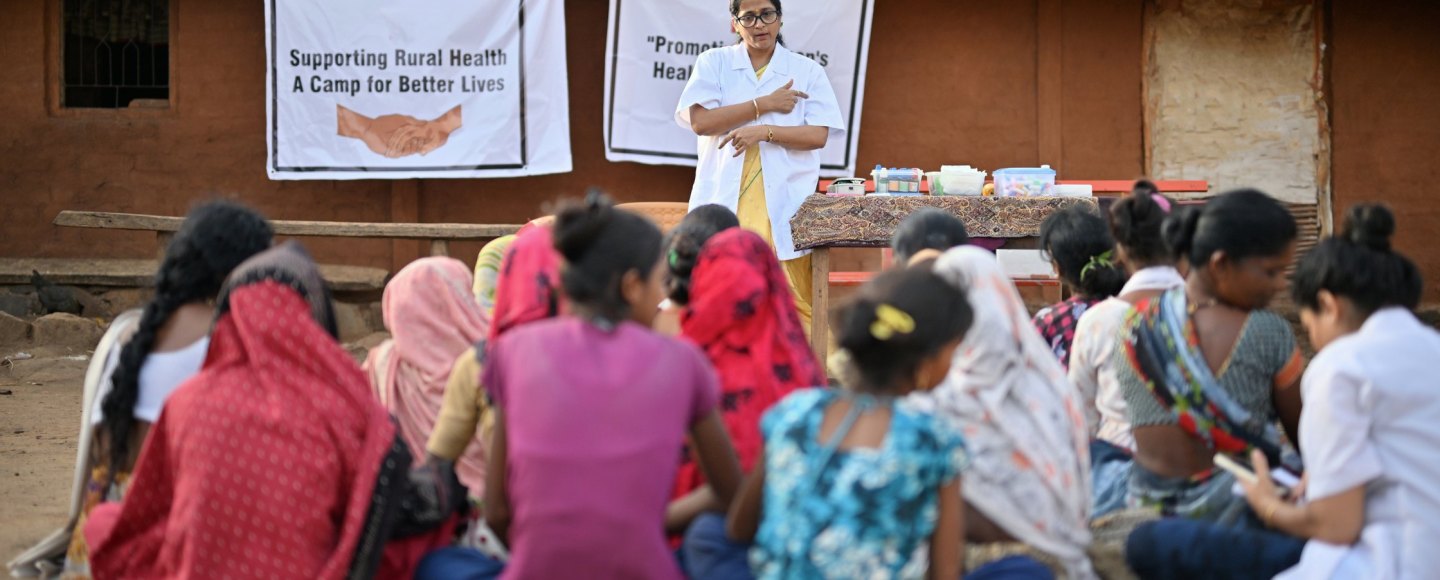

In her new memoir Staying Alive: Dispatches from the Margins (Pan Macmillan, 2026), veteran public health physician Dr Ramani Atkuri exposes the stark inequities of India’s healthcare system. The book is an urgent critique, illuminating how marginalized communities – particularly rural women and tribal populations in India’s heartlands – are systematically left behind by a fractured medical infrastructure.
Drawing from three decades of frontline experience across Madhya Pradesh, Odisha and Chhattisgarh, Atkuri chronicles how inadequate facilities, personnel shortages, dismal public spending and detached policy decisions dictate survival. Her experiences testify that healthcare in India is a deeply political battlefield shaped by the intersections of caste, class, geography and gender.
An alumnus of Christian Medical College, Vellore, Atkuri worked with UNICEF for a decade from 1997 before returning to the grassroots with organizations such as Jan Swasthya Sahyog, a volunteer-run nonprofit of health professionals.
This excerpt from the book is published with permission from Pan Macmillan.
By Ramani Atkuri
There has been a push for digitization across all spheres of governance in India, based on the belief that it will enhance transparency, curb corruption, streamline administrative processes and strengthen programme monitoring and management. However, in social sectors like health, nutrition, pensions or subsidized foodgrains, digitization has been a double-edged sword.
Santoshi Yadav is a bright young woman, recently appointed as an Anganwadi worker (AWW) in Majhipara (also known as Birhorpara), Chhattisgarh. Since this is a mini-Anganwadi center (AWC), she works alone, without a helper. Mini AWCs are smaller facilities established in remote and underserved communities to improve nutrition and health services for women and children. She was an Anganwadi helper for six years before her appointment.
The Birhors are classified as a particularly vulnerable tribal group (PVTG), characterized by high levels of poverty and malnutrition. This hamlet has 33 Birhor families with a total population of 119. Ten of these families live deep in the forest, while the rest live at one end of the main village.
The mini-AWC runs from an unused room of the village’s primary school, where the 20 enrolled schoolchildren gather for lunch at 1 pm. The Anganwadi children vacate the room for the next 30 minutes and play outside, allowing the older children to eat inside. No equipment has yet been provided to measure the children’s height or weight. However, rations are provided for enrolled children and mothers.
Santoshi is happy to be an AWW, but that day she was frustrated. She had been able to enrol only 10 of the 21 eligible children in her village, and none of the pregnant women. This was due to the highly complex and time-intensive process of registering women and children in the Poshan Tracker app, which is mandatory for service eligibility.
I asked her to explain the process to me, and we spent the next hour navigating the app. At least half the time was spent waiting for the internet connection to become strong enough to open a particular window or move on to the next screen. We spent at least four minutes waiting for each screen to open. She had received a tablet from the government to install and use the Poshan Tracker, but it stopped working a few weeks later. She was therefore using her personal phone for this.
A child can be enrolled using their Aadhaar number or that of either parent, although in practice, only the mother’s details are usually recorded. None of the children in this hamlet had Aadhaar cards, which require a birth certificate for issuance, a document none of them possessed.
Although the system allows enrolment using the mother’s Aadhaar number, it requires a two-step authentication process: e-KYC (Know Your Customer) verification via a one-time password (OTP) sent to the registered mobile number linked to the mother’s Aadhaar, along with biometric confirmation via facial recognition.
Most women do not have a mobile phone, and often no one in their family does. Some have lost their phones or changed their numbers, with the updated number not linked to their Aadhaar. In all such situations, the OTP cannot be verified. A few women provide their husband’s number, but he is often unavailable due to seasonal or long-term migration outside the state.
When the AWW calls to request the OTP, they either do not hear the phone ring or refuse to share the OTP with an unknown caller. In some cases, repeated calls have led to irritation or hostility. If there had been a provision for manually including exceptions, many women and children could have been prevented from being excluded from the system. At present, no such alternative pathway for enrolment exists.
Santoshi expressed deep frustration with the process. She had used her own mobile number to enrol some children, but explained that she could not extend this to all families. The facial recognition software is very slow and often fails to validate the beneficiary. The process must be repeated several times before it is successful. If the woman’s Aadhaar number needs updating or linking with a mobile number, she has to accompany them to the block office to get it done and bear the cost of transport.
Her supervisor, however, does not want to hear Santoshi’s explanations and insists that all beneficiaries be enrolled regardless of constraints. Under the earlier paper-based register system, she could always explain gaps in the required details. But now, the digitized platform does not accept incomplete entries and rejects any application that lacks complete information. Isn’t it possible to find a simpler way to enrol eligible people into the system?
“But Birhors are PVTGs, poor and many do not own cellphones. Why can’t we make exceptions?” asks Santoshi.
Why not, indeed!
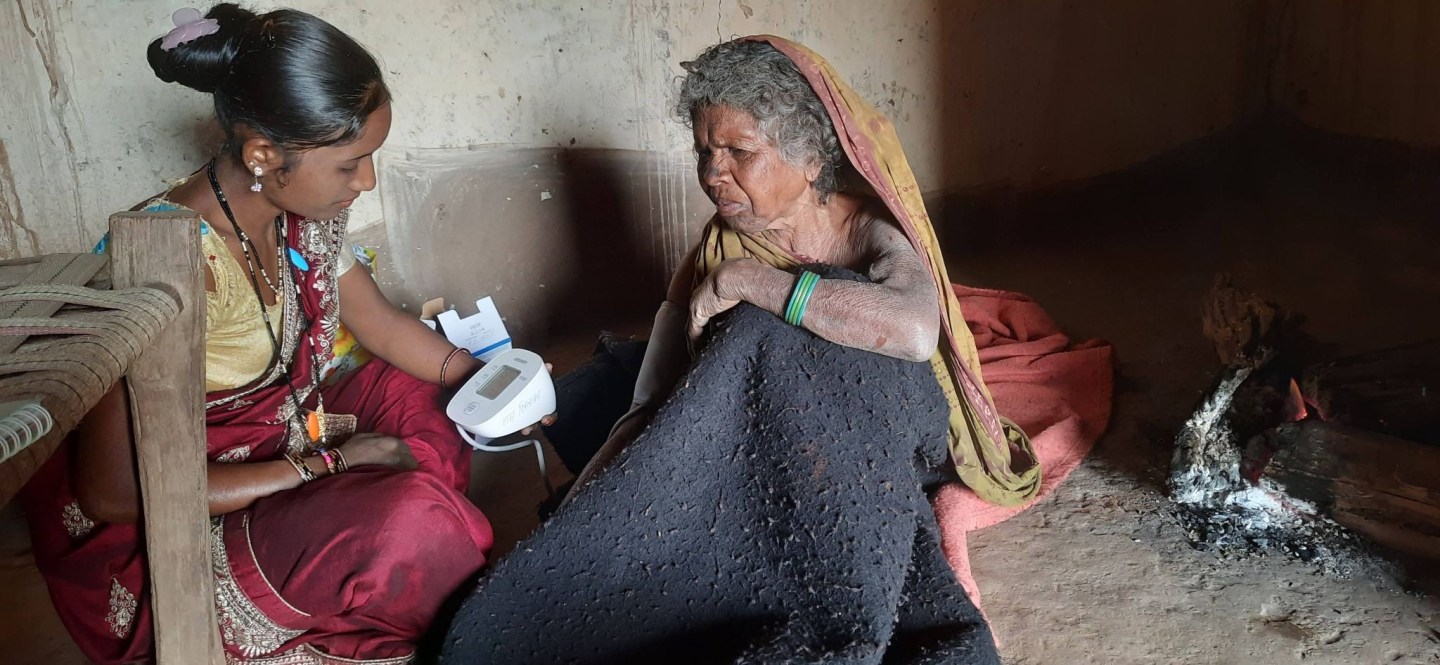
Women pregnant with their first child are entitled to a conditional cash transfer of ₹5,000 during and after pregnancy, provided they are over 18 years old. Failure to be enrolled in the Poshan Tracker app makes them ineligible for this benefit.
For pregnant and lactating women receiving dry rations as supplementary nutrition, identity authentication via e-KYC and facial recognition is required at registration. In addition, biometric facial recognition must be repeated each month before they can be given rations.
For children receiving a hot cooked meal, photographic evidence of them eating it must be uploaded as proof of ‘liveliness’. Santoshi photographs the children as they eat each day and uploads the images through the application. Of the 10 enrolled children, eight are between three and six years of age. The centre, therefore, receives rations for hot cooked meals for eight children.
However, another five children attend the Anganwadi but are not enrolled. Santoshi distributes food among all 13 children, explaining that she cannot allow some children to starve while others eat. Pregnant women who are unable to enroll in the system continue to receive their tetanus toxoid injections and iron tablets from the auxiliary nurse midwife (ANM), but do not get the monthly supplementary nutrition packets. A six-and-a-half-year-old child often attends the Anganwadi too – he has been refused admission to school because he does not have an Aadhaar card.
Santoshi records the weight of the Anganwadi children every month using the weighing scale she borrows from the mitanin (health worker or ASHA) in her village. For height, she uses a tailor’s tape fixed against the wall of the Anganwadi room. However, only information about the eight enrolled children can be uploaded into the system. The five others remain untracked for their nutritional status. They do not exist in the eyes of the administrator.
Santoshi does not know who looks at the data uploaded from her mobile phone app, but she is sure that no one in her center is malnourished.
Lead image: Mayur Kakade
Discover more from eShe
Subscribe to get the latest posts sent to your email.
0 comments on “App-based public health services adding to systemic barriers for India’s marginalized”