
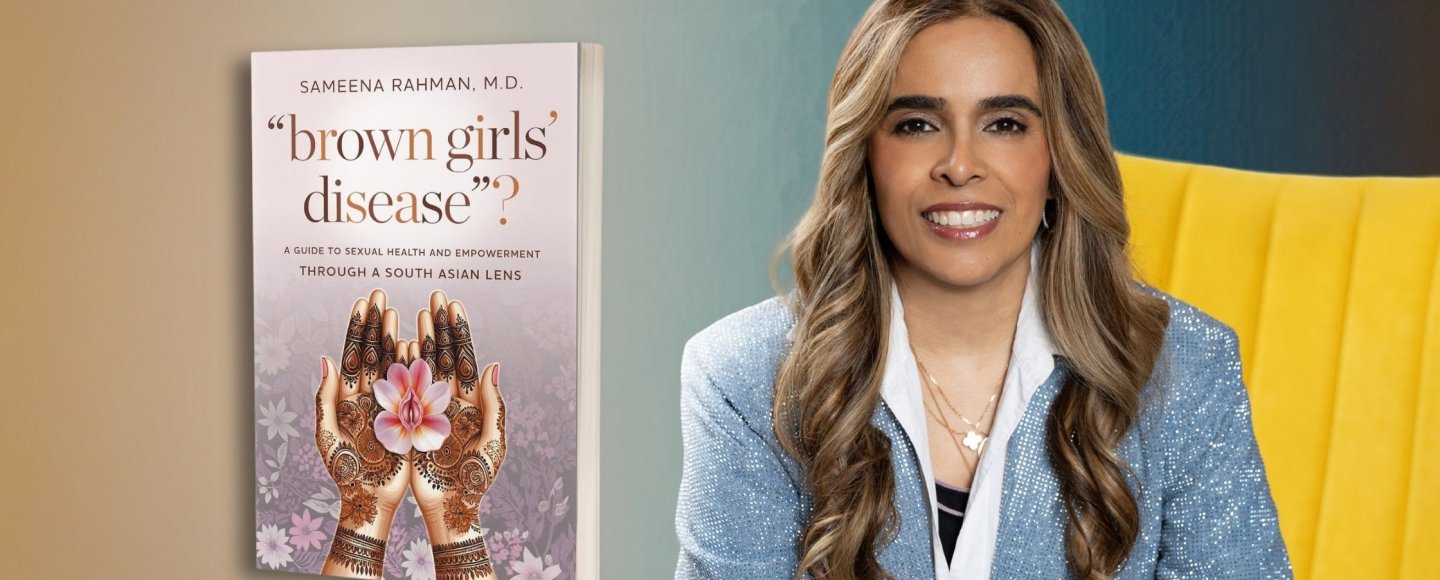

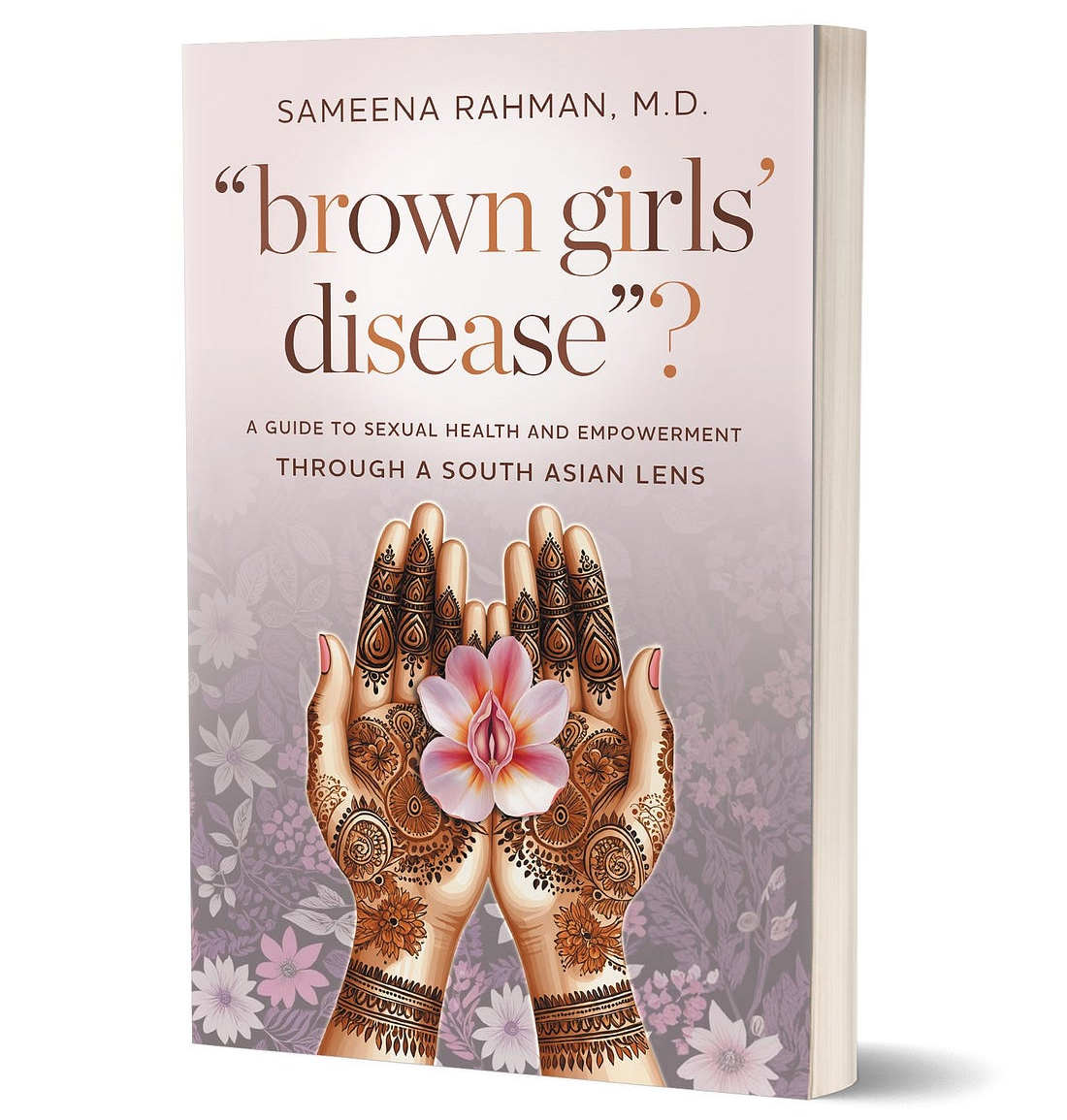
In her new book Brown Girls’ Disease? A Guide to Sexual Health and Empowerment through a South Asian Lens (2026), Dr Sameena Rahman examines a deeply feminist question: what happens when women’s bodies, pain and sexual health are shaped by systems that were never designed to fully hear them?
Through discussions of vaginismus, libido, arousal, postpartum health and more, the Chicago-based gynecologist explores how cultural expectations and entrenched ideas about femininity can prevent women from speaking openly about their bodies.
A board-certified OB/GYN, sex-medicine gynecologist, menopause specialist and clinical assistant professor of OB/GYN at Northwestern Feinberg School of Medicine, Dr Rahman is the founder of the GYN & Sexual Medicine Collective and host of Gyno Girl Presents: Sex, Drugs & Hormones.
Her new book is both a medical guide and a feminist intervention: a call for South Asian women to question inherited silences, challenge dismissive healthcare, reclaim bodily autonomy and demand care that recognizes them in the fullness of their cultural and lived experiences.
This book excerpt is published with permission from the author.
By Dr Sameena Rahman
Let me take you back to the months right after 9/11, when this country was engulfed in fear and uncertainty. It was a tragedy that shook the nation to its core, but it also produced a deep-seated fear and widespread mistrust toward Muslims. For those of us who are Muslim, it was a stark reminder of what happens when overnight you find yourself labeled as one of “them”.
I was brought face to face with this reality not long after 9/11, in the hospital where I had just started working as a first-year resident. During my OB/GYN rotation, a Muslim patient of mine was having a hard time during a pelvic exam. It wasn’t simply that she was uncomfortable – she was in pain. Anyone could see this, and she said so herself, repeatedly. But when the attending physician saw this, she wasn’t concerned or even sympathetic. She was impatient.
“What’s the deal with your people?” she turned to me and blurted out as we stepped away from the patient. “They act as if they’ve never had anything in their vagina.”
I just stared at her. What do you say when brought face to face with racist bias? And she was a woman speaking about another woman. I was just in my first year of residency – I didn’t know what I could say. But I knew what I wanted to ask: If you’re talking like that to me, what do you say to your patients?
It was one of the first times I was slapped in the face by medical bias. But it wouldn’t be my last.
The fact is, this particular bias is so pervasive, so embedded in the culture of women’s sexual health in this country, that it has a nickname in some healthcare circles: “Brown Girls’ Disease”.
I wish I was making that up.
The disease that doesn’t exist
“Brown Girls’ Disease” isn’t a condition you’ll find in any medical textbook or board exam, but you’ll hear it discussed in certain OB/GYN clinics, among doctors and nurses. And note: I don’t say whispered.
That’s how ingrained this bias is – people believe it’s an actual thing.
I wish I could tell you this was historical, something from a dusty medical textbook that no one reads anymore. But I’ve heard it said to my face. This is the present I’m talking about.
Right now, today, in clinical settings across this country, doctors and nurses talk about “Brown Girls’ Disease”, rolling their eyes and shaking their heads to describe South Asian women who experience involuntary pelvic floor contractions during examinations. It reflects a deep-seated bias in women’s healthcare that’s far more pervasive than most clinicians are willing to admit.
The numbers tell the story. In 2020, we conducted a study via anonymous survey of Muslim women in North America that demonstrated 41 percent of over seven hundred respondents experienced sexual pain in their lifetime. However, over 60 percent of these women never sought treatment.
The reasons? Distrust of the medical community, fear and shame.
This isn’t just about misdiagnosis – these biases have a profound, often devastating impact on patient care. When someone has pain during tampon insertion, they’re told to “just relax, sweetheart.”
Pain during sexual intercourse? “Try a glass of wine. That didn’t work? Try another.”
When your doctor’s treatment plan could have been dispensed by a bartender at last call, you’re not receiving medical care – you’re experiencing bias.
When medicine fails women
The condition my patient from 20 years ago was suffering from does have a name: vaginismus. It’s characterized by involuntary contraction of the pelvic floor muscles, leading to discomfort or pain during intercourse, tampon insertion, or pelvic exams. There are effective, readily available treatments – but it’s a condition that continues to be heavily stigmatized and particularly prone to being seen through a biased lens.
This reflects a broader problem in medicine itself. For too long, medical education and research have been heavily skewed toward male physiology, with female health issues being sidelined or misunderstood.
Take the clitoris, for example – the only human organ with the singular purpose of providing pleasure, and the least studied in the medical community. I saw a TikTok recently where a woman explained that the clitoris has 8,000 nerve endings. Sounds impressive, right? Well, that statistic is from a cow, from a study done in 1976. Right, because bovine pleasure was clearly the pressing research priority of the 1970s.
It wasn’t until a few years ago that an actual study was done on the human clitoris and found it has well over 10,000 nerve endings.
And it wasn’t until 1993 that women were even required to be included in clinical research. This is why, on average, women get diagnosed four years later than men across over 700 disease states. Turns out, when you base medical knowledge primarily on male bodies, female bodies become medical mysteries.
This knowledge gap – this empty space of medical ignorance – gets filled with cultural stereotypes and racist preconceptions. And the impact is devastating.
Why I had to write this
I know both sides of this problem intimately.
I’m the daughter of Pakistani Muslim immigrants. I grew up in the American South in a household where sex wasn’t discussed – even menstruation was a whispered secret. At 30 years old, I had graduated from an OB/GYN residency but had never had a gynecological exam or used a tampon. I knew nothing about my own reproductive anatomy.

The irony wasn’t lost on me: I became a doctor for women while remaining completely ignorant about my own body.
When I finally worked up the courage, it was my BFF, Dr Jeanette Lee, who helped me. As a Korean-American she understood the cultural complexities. She gave me Valium for the anxiety and performed my first Pap smear with a gentleness born of understanding.
She didn’t judge me for being 30 and terrified. She didn’t make me feel broken or strange. She simply helped.
That experience showed me the power of culturally informed care. But it would take a special patient – years later – to change my entire approach.
A South Asian Muslim woman came to see me. Her marriage had been unconsummated for seven years because of pain. Seven years of suffering. Seven years of medical appointments that led nowhere. Her family was pressuring her to have children, but she couldn’t even take the first simple step.
As her story unfolded, I realized something horrible: I didn’t know how to help her. I simply didn’t know enough. That moment of humility became the turning point in my career.
I sought additional training, learned to bridge the gap between cultural understanding and medical expertise. Over time, word spread.
More women – especially South Asian women, especially Muslim women – came to see me because they’d heard I wouldn’t judge them.
My new book is the result of what I’ve learned, what I wish I’d known sooner, and what I want every woman and women’s healthcare worker to know – regardless of ethnicity.
My hope is that my stories will offer both knowledge and inspiration.
Reclaiming our stories
The impulse to label and dismiss has deep roots in medical history.
From ancient Greece to the early 20th century, women’s unexplained pain was routinely diagnosed as “hysteria”. In the 1980s, doctors labeled AIDS as “gay cancer”. When medicine refuses to see patients as full, complex human beings, it makes problems worse instead of solving them.
Calling women’s sexual pain “Brown Girls’ Disease” turns a legitimate, understandable response into a punchline. It stops doctors from asking why a patient is flinching, why she can’t use a tampon, why she can’t orgasm. It trains the system to dismiss her instead of helping her.
That’s why I’m reclaiming my attending’s dismissive term. I’m turning it from an insult hurled in a hospital hallway into a rallying cry for better care. Because there is nothing diseased about cultural modesty. Nothing wrong with needing time to feel comfortable with intimate examinations. Nothing abnormal about wanting a healthcare provider who respects your background and values.
What’s diseased is a medical system that treats cultural differences as pathology instead of adapting to serve diverse patients.
Discover more from eShe
Subscribe to get the latest posts sent to your email.
0 comments on “‘Brown Girls’ Disease?’ How medical systems dismiss and fail South Asian women”