

By Vaishnavi Roy
There are forms of grief so quiet, they become furniture. You don’t see them anymore; you live around them. You pour tea next to them. You grow used to their stillness. That’s how we often imagine grief lingers in the widow houses (vidhwa ghar) of India. An unbearable stillness that hums in every room.
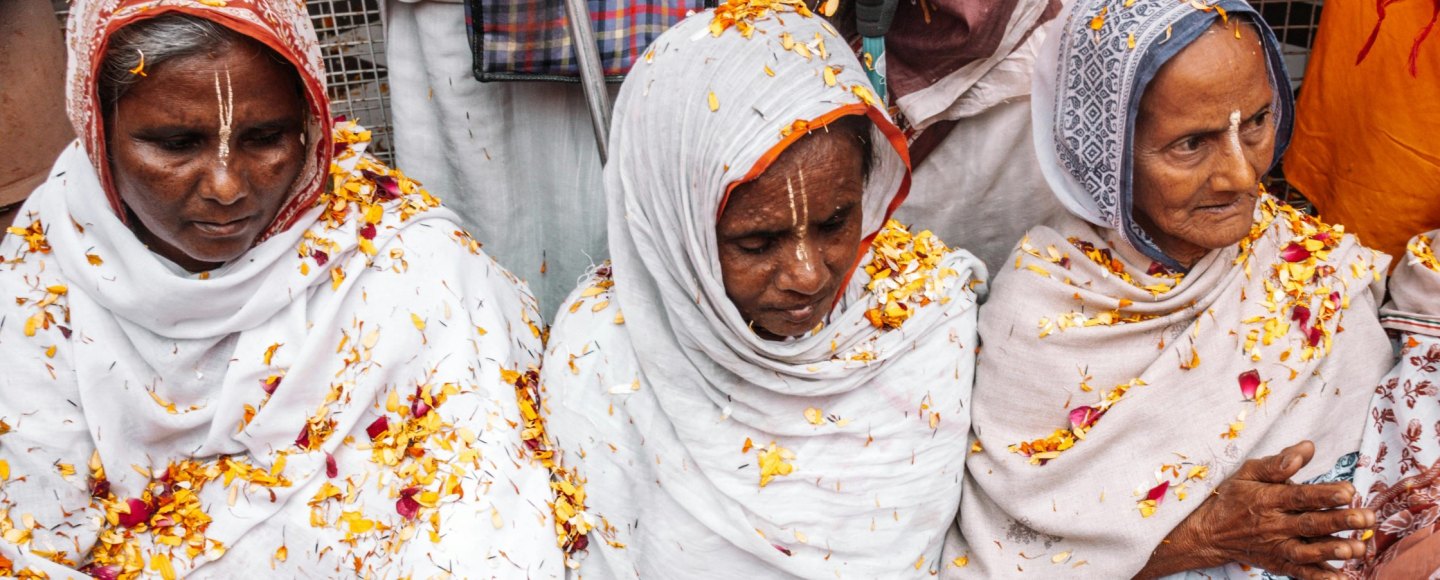
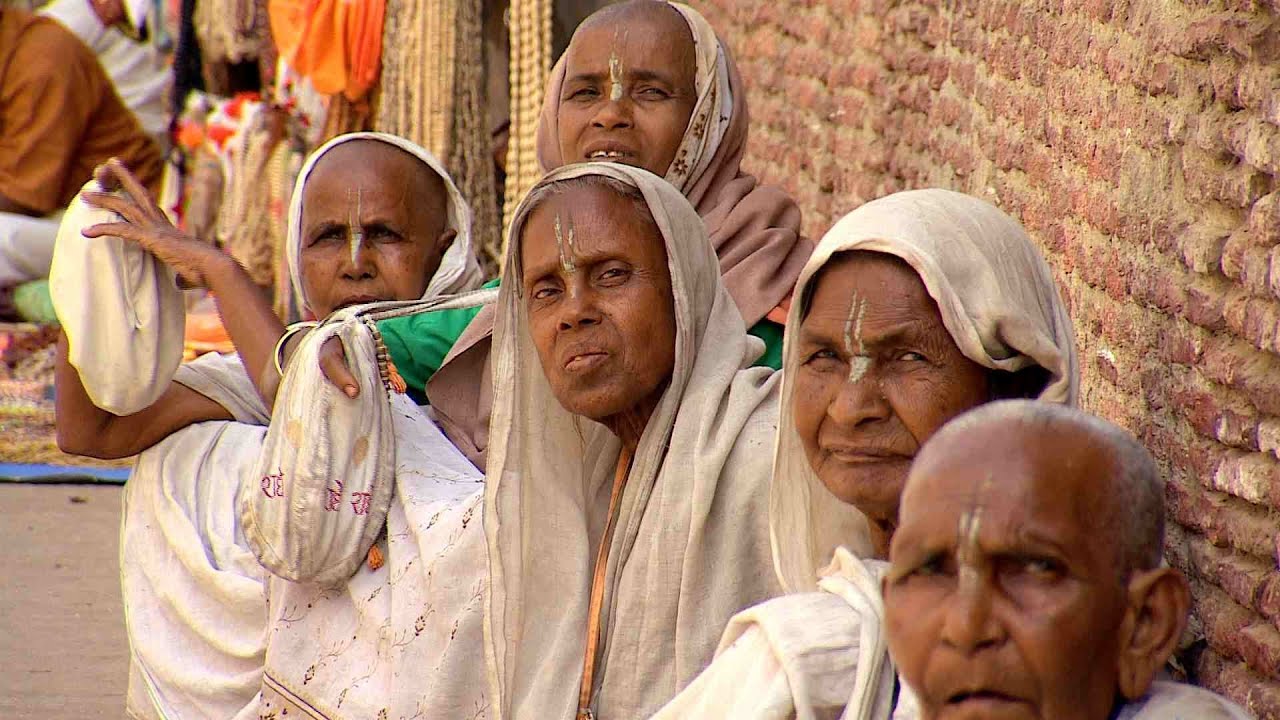
There are thousands of widows in the holy city of Vrindavan – many cast off after the deaths of their husbands, some abandoned by families, others walking into exile under pressure disguised as choice. Their sin? Outliving a man. Their punishment? A lifetime without touch.
According to the 2011 Indian Census, there are about 56 million widowed persons in India, 78% of whom are women. Many of them, especially those in places like Vrindavan, are condemned not by law, but by custom – stripped of identity, purpose and human warmth.
More than two centuries have passed since the brutal ritual of Sati – the burning of widows on their husband’s funeral pyres – was outlawed. But the ideology behind it never really died. It simply changed shape. It lingers in whispers, in stares, in the quiet exclusion of widows from rituals, festivals, even from conversations. She is no longer forced into the fire, but often, she’s still erased from life.
Colonial rulers didn’t just ban an ancient practice – they reframed widowhood itself. It became a metaphor for cultural backwardness, something to be pitied, policed, or pushed aside. And in doing so, the isolation deepened.
This kind of pain isn’t just Indian. It echoes across continents. In the Appalachian hills of America, widowed women often drift into social exile, no longer invited, no longer needed. In Japan, there’s kodokushi – the phenomenon of dying alone, unnoticed for days or weeks, in cramped city apartments. And in Western eldercare homes, grief hides behind sterile walls and polite smiles. There, touch starvation becomes a daily ache – where no one hugs you, no one strokes your face, no one sees the person you once were.
Their grief – scattered across lands and cultures – is a haunting testament to a basic human need denied. They are not in prison, but the sentence is just as long.
In the quiet alleys of these widow homes, what strikes isn’t the absence of luxury but the absence of contact. There are caretakers. There is food. There may even be chanting. But what you won’t find is a loved one’s hand on a shoulder. A hug in the morning. A head resting gently in another’s lap. That kind of touch – soft, human, uncalculated – is the first thing to vanish, and the last thing to be mourned.
We like to pretend affection is optional. It isn’t.
Science tells us that touch lowers stress, strengthens immunity, and floods the body with oxytocin – the hormone we associate with love, safety, belonging. But science doesn’t always have language for the slow ache that settles in when no one has held your hand in days. When your body forgets what it feels like to be wanted. When skin becomes a border instead of a bridge.
We live in a time when mental health is finally becoming part of everyday conversation. And yet some wounds stay invisible. Touch deprivation is one of them. These women are alive, yes. They breathe, they walk, they eat. But socially, emotionally, even spiritually, many are already ghosts. It is not death. It is social death.
The term sounds clinical, but its sting is ancient. Social death occurs when someone is stripped of their roles, their recognition, their place in the human map. For Indian widows, it often begins with the sindoor being wiped from the forehead. The bangles broken. The colour removed from clothing. But the deepest deletion happens in the body — in the absence of affection, of eye contact, of emotional affirmation.
To be a widow in India is to be put on mute.
It’s no accident that this muting is gendered. Male grief, if expressed at all, is allowed to be dignified, solemn, restrained. But female grief is policed. A woman without a husband is, in many communities, seen as either dangerous or disposable. She is too much or too little. Too visible or not visible at all. Her desires are threatening. Her presence is embarrassing. Her touch? Taboo.
The rituals of widowhood are not just about mourning. They are about erasure. And the erasure begins with the body.
In traditional Hindu frameworks, a woman’s identity is often braided so tightly with her husband’s that his death isn’t just a loss; it’s a social unmaking. Suddenly, she is untethered. Not quite wife, not yet anything else. She becomes terrain no one wants to claim. To decorate her own skin becomes defiance. Red lips are provocative. A bindi feels audacious. A smile? Almost offensive. Over time, they internalise these scripts – shrinking into the roles carved out for them, apologising, subtly, for still breathing.
What makes this wound deeper is how thoroughly it hides behind what we’re told is holy – wrapped in the soft language of ritual, of devotion, of righteousness. Take Vrindavan, for instance. Called the “city of widows”, it offers shelter, yes – but for many, it’s not sanctuary. It’s exile with a spiritual cover story.
We don’t often question systems that claim to be sacred. But perhaps we should because what is the price of purity if it requires the extinction of warmth? What kind of holiness demands that a woman vanish from the world just because she loved once, and lost?
But the human heart is disobedient in ways we can’t measure. It does not vanish on command. Instead, it rebels – subtly. In sleepless nights that feel endless but don’t make headlines. In odd body pains no doctor explains. In that ache that isn’t pain exactly, but something more haunting. Like the feeling of being unmissed.
And this is what no one says out loud: ageing isn’t the tragedy. Becoming invisible is.
How many of these women remember being held? Not out of pity. Not as duty. Just… held. I wonder. When was the last time someone touched their face without rushing? Or brushed their hair, not for hygiene, but with love? Sat next to them and stayed – not to monitor, not to caretake, just to be there?
And yet, not all surrender.
Some find loopholes. A hand clutched a second longer during prayer. A shoulder leaned on in the late afternoon. A joke whispered between dentures that ends in laughter and a casual, accidental nudge. These aren’t just moments. They’re rebellions.
They say: I am not done yet. I am still someone. I still feel, and I still want.
The world may have forgotten. But the body hasn’t.
And that matters – because we’ve built a culture that celebrates self-sufficiency while quietly killing the truth: we survive through each other. Especially in grief. Especially with age. Especially when the world stops looking at you altogether.
This isn’t a manifesto. It’s not rage.
It’s a slow, aching question:
- Can any tradition call itself sacred if it forgets what it means to be human?
- Can a culture truly be spiritual if it demands its women disappear quietly, in the name of dignity?
Somewhere, right now, an old woman is reaching out in her sleep. Not for salvation. Not for God. But for a hand to hold. And maybe that is what this story is about. Not widowhood. Not exile. Not even religion. But the simple, radical act of remembering that she exists.
No one should live a life where the only time they are touched is when they die.

Vaishnavi Roy is an award-winning author and mental-health advocate based in Delhi. Follow her on Instagram.
Lead image: Saikat Ghosh
Discover more from eShe
Subscribe to get the latest posts sent to your email.
 eShe
eShe 
This is a truly moving and a shocking story.
What is the fault of these widows? They have outlived their husbands?
Our Hindu culture teaches us to treat our mothers as Godesses, then why are they exiled into ashrams to lead a life of suffering? They have equal rights in their families and in our toothless society.
The children to whom these mothers gave birth should be ashamed of mistreating their mothers.
As a Hindu, I hang my head in shame…
The society at large, the multimillionaires bragging with their tons of money and ‘tujhe pata nahi me kaun hu’ attitude should set an example by improving the plight of these hapless women and establishing care homes with staff to care for these women as they grow old.
Vaishnavi Roy ji, thank you for this enlightening article. It will haunt us for a long time.
Shamlal Puri
Senior Editor UK & Associate Publisher
Diaspora Times Global, London
LikeLike
Before reading this article, I used to think widows in Vrindavan are living a peaceful spiritual life by doing bhajan and staying near temples. I didn’t know the full truth ,But after reading what the writer Vaishnavi wrote my thinking changed. it is not just emotional article , it is also full of facts. I don’t just feel sad for them but I feel more aware. I see them with more respect now. They are not just any other ‘widows’ they are strong women, surviving every day with so much courage. Thank you to the writer for giving me different perspective.
LikeLike
No one should live a life where the only time when they are touched is when they die. The article enumerate the significance of a simple act of touch in our daily living which when deprived forms a grief in which one dies every moment living in disguise, a shadow looming large thereon, so beautifully articulated by Vaishnavi Roy with so much empathy. Lord Shri Krishna being propagated to have married sixteen thousand women thereby giving them self identity is based on falsehood behind which gender bias is protected to abuse and let the weaker gender suffer and make it look like a upliftment. With the changing times, environment, living, the traditions should be made available for challenge to see if it’s appropriate or to discard as well. Nothing is holy, which has no touch of humanity.
LikeLike
Excellently researched
LikeLike
Touched a very deep topic must read
LikeLike
This is such an important piece and deeply moving . thank you for writing it.
LikeLike
A life without colour, a life without voice — the widows of Vrindavan live a lifetime of waiting. Waiting to be seen, to be heard, to be touched with dignity. In their silence, they are still reaching out — for a glimmer of compassion, for the return of the rainbow.”
LikeLike
well written!
LikeLike