

By Sanjana Rathore
Urban singles who live away from home often speak of missing ‘maa ke hath ka khana’ (mom-made meals). But have you ever thought about why it is never ‘papa ke hath ka khana’? Most of my friends in college often rant about their urge to have homemade food. But what they really mean by that is their mother’s cooking. And I don’t find it odd because that’s what we have all seen around us.
Who runs your kitchen – older sister, aunt, mother, mother-in-law, daughter, or daughter-in-law? What’s common among these figures is that they are all women. Primarily a survival skill, cooking has, over the centuries, become much more than just the process of making food. It is intertwined with gender bias, culture, stereotypes, societal food standards and work division.
We have grown up seeing the women of the house cooking while the men are considered breadwinners who need not contribute in the home. This legacy has been passed on from generation to generation. That’s why expecting to see women in the kitchen thrice a day is quite common for us. It sounds shocking to hear a woman say, “No, I don’t know how to cook,” especially if she has the responsibility of kids and a family.
A ‘Good’ Woman
I heard one of my aunts say about our new neighbour, “She doesn’t even know how to cook; what kind of a woman is she?” I was startled to see them judge the character of a woman based on her cooking skills. Why does it even matter?
Over the centuries, cooking has been glorified as a skill of a ‘good’ woman. By the 1970s, women began opposing this idea. Yet, in patriarchal societies like India, no matter how educated or financially successful the woman becomes, nothing can emancipate her from the duties of cooking. It is considered a woman’s responsibility to cook for the family, regardless of being employed in wage work outside all day. This defies the logic that is applied to employed men.
Read also: Housework is NOT a woman’s job, her choice or her dharma
Some modern educated women refuse to fit into this conventional norm. However, it doesn’t mean that they have been able to separate themselves from it. Regardless of the gains of feminist movements, the responsibility of preparing meals for kids and the family ultimately falls on women. They are made to internalise this role, and often feel guilty if they cannot or do not want to do it.
Women are supposed to cook for their family out of love. If they don’t, they’re labelled ‘narcissists’ or ‘selfish’.
Gender Gap in Cooking
Has feminism empowered women and improved their status in households? Not really. According to a Gallup study, the gender gap in household cooking has widened in previous years.
The percentage of women cooking increased steadily in 2022 to 8.7 meals per week. On the contrary, the rate of male cooking declined by 0.7 meals making their average just four meals per week.
According to another survey in The Economic Times, around 75 percent of women in Maharashtra have only 30 minutes to dedicate for self-care. Further, 84 percent women of Nashik feel that if they spent less hours on cooking, they’d have more time to follow their passions.
Read also: ‘The Great Indian Kitchen’: a necessary dialogue on ridiculous patriarchal norms in marriage
These reports make it clear that it is still primarily women who handle home-cooking at the cost of other pursuits. But the opposite is true when it comes to cooking in restaurants or professional cooking.
“When you see women in the kitchen you think it’s a domestic thing and when you see men you think it’s a creative thing. That’s what we need to change,” says chef and activist Alice Waters. The ingrained belief in most societies worldwide is that men’s cooking is connected with creativity and professionalism, while women’s cooking is a personal responsibility.
Is this because society fears women’s power, and what they can do if they really understand their cooking’s worth? Perhaps women would rebel and not remain confined to the kitchen anymore. And that would disrupt patriarchy.
Television Endorsement of Mom-Made Meals
Have you ever watched Taarak Mehta Ka Ooltah Chashmah? This comedy entertainment minces no words about women’s roles in the home and in society. None of the female protagonists in the show is an independent woman, and all cook for their families.
Daya, wife of Jethalal, is continuously valued for her cooking skills. She dedicates all of her time to cooking and serving her family. Starting from breakfast, she spends most of her time in the kitchen, cooking something special for them every day.
All the women believe that this counts as a characteristic of a ‘sanskari bahu aur patni’ (dutiful daughter-in-law and wife). At times, when she gets late from shopping or somewhere else, Daya can’t stop apologising for not having prepared the meals.
This show is immensely popular and replicates the mindset of society. Although it does take up several social issues, it lags behind in challenging the conventional norms when it comes to gender-food equality.
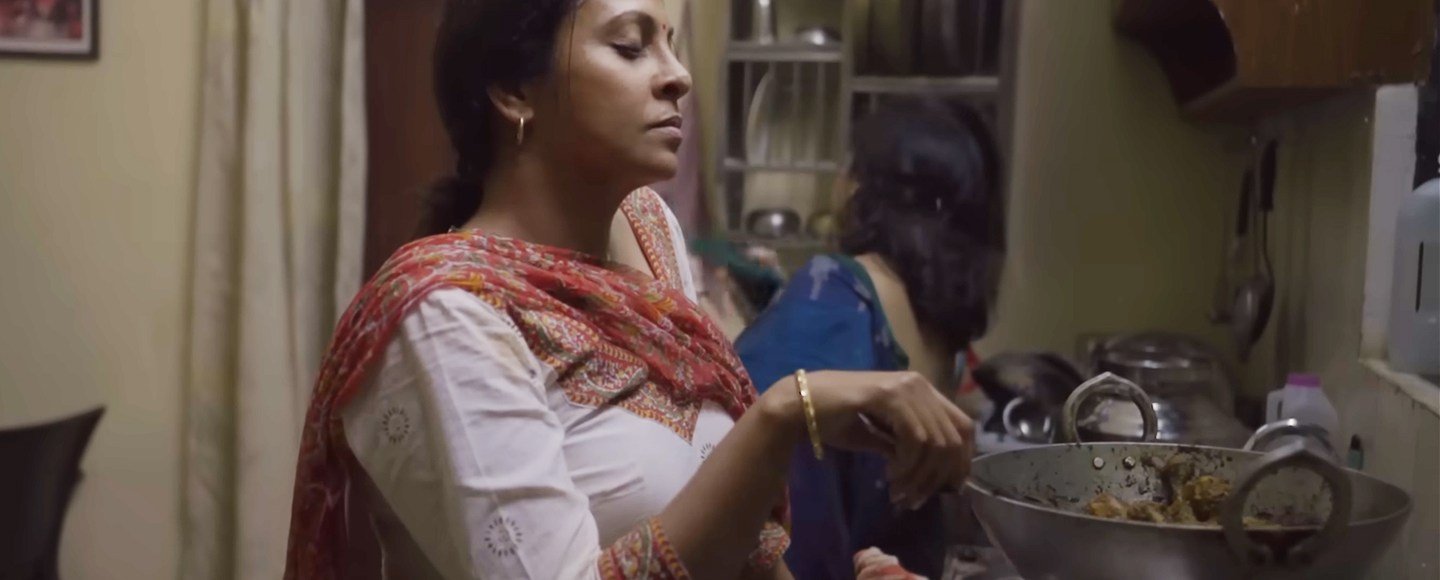
The 2017 short film named Juice starring Shefali Shah (lead image) portrays very realistically how women are forced into the heat of the kitchen while men gossip and switch TV channels sitting in front of a cooler in the living room. Directed by Neeraj Ghayvan, the film also shows that a woman is never a guest even in someone else’s home, but only a helping hand in the kitchen.
The Politics of Cooking
Unsurprisingly, the politics of food isn’t limited to cooking but extends to serving and eating meals as well. In Juice, there are four children at the party – one girl and three boys. When it comes to serving food, only the girl is called out and the boys are left to play video games.
It is a stark portrayal of how society begins to sow discrimination from childhood. The girl child is always taught to serve the boys and men in the family first. This partiality extends to their share of nutrition as well.
“Let your father and brother eat first. I think there are fewer rotis today,” my mother sometimes said to me. I was surprised to see how the makers don’t get enough meals themselves. Although women prepare all the food, they are the last ones to eat it. Why?
What kind of family love or connection is this where women need to compromise with their share of food? Or is this yet another way to emphasise that women’s needs are subordinate to men’s?
That’s what society is like. But we have to ignite change by challenging these stereotypes and normalising a new dynamic where it’s okay for women not to cook at home, and just as normal for men to go into the kitchen and cook after coming home from work.
And the ones who decide to be homemakers must be aware of their worth.

Sanjana Rathore is a Delhi-based content writer and blogger focusing on women’s issues, travel, and lifestyle. You can find her on LinkedIn and Medium.
Discover more from eShe
Subscribe to get the latest posts sent to your email.
 eShe
eShe 
Okay lets see It this way – You dont force men to be the breadwinners and men dont force women to be cooking specialists. Isn’t It that simple? Leave about forcing men to be the breadwinners, Modern women elope with other men, or directly shift back to their parents house or start living independently and demand alimony(by seeking divorce), the moment men lose their job. Just imagine the situation If he is injured in an accident and is unable to work for life! Simple, until women cannot accept men’s responsibilities as truly theirs and Indian courts start supporting reverse alimony if husband is unemployed, they should never expect men to accept women’s responsibilities!!
LikeLike
Also, please stop supporting women(only referring to modern educated working women here, less educated women are far better), when you know how many fake alimony cases are being put up by them just to extort money from husbands, as Its the husbands responsibility to always provide, per Indian court laws. You dont want to raise awareness for men’s safety but support women who already have Indian laws favoring them?? Wah re wah, Sanjana Rathore proud of you!!
LikeLike
Excellent topic. Juice was such a good film. We need to dissect all these topics
LikeLiked by 2 people
Apart from cooking women are supposed to do dishwasdhing dusting and cleaning of their homes
which is really condemnable in the sense why men hesitate to do it? There is a dire need of hour
to change this vicious circle. Think over it seriously.
LikeLiked by 1 person
I salute Sanjana for writing such a nice article about cooking of women in India.I consider a sort of slavery for housewives for cooking meals three times ina day without any break throughout the year. Hell to this Goddamned tradfitionfor punishing women so severely. Men also share in cooking as they are notso sacred. Hats off to the author with hugs and kudos!! Shakil Ahmed (Shokee)Lahore Pakistan
LikeLiked by 1 person