


By Sambrita Saha
Growing up in a Bengali household, the kitchen was more than just a room. It was a universe of smells, spices and silences. My grandmother moved through it with grace, never questioning why she was always the first to wake and the last to eat. My mother followed, less out of joy, more out of obligation.
For years, I watched them, absorbing their quiet efficiency, not knowing that those rituals were also shaping me.
When I chose to study food science, most people thought I was preparing for a “feminine” profession. After all, hadn’t women always been linked to kitchens? But what I discovered in classrooms and textbooks was far more layered.
Food, I realised, is not just about taste or health – it is deeply political. It is about access, control, identity. And very often, it is about gender.
I remember one of our lectures on food systems and sustainability where the professor casually mentioned how global food policy is still predominantly shaped by men. At that moment, I thought of all the nameless women who grow, cook and serve food every single day without any recognition.
Their knowledge – passed through generations – is rarely documented, let alone respected in academic or policy circles. That irony stayed with me.
At home, I began to see things differently. The compliments for my father’s rare Sunday chicken curry far outweighed the routine excellence of my mother’s meals. Her effort was expected, his was celebrated.
It’s funny how praise can be political too.
During a recent family gathering, while the men sat comfortably discussing elections and economics, the women floated around with trays of tea and plates of snacks. I was helping too, and someone remarked, “You’ll make a perfect wife.” I smiled, but inside, I wanted to ask – why not a perfect scientist?
These experiences made me rethink my understanding of feminism. It’s not just about protest slogans or viral hashtags. Sometimes, it’s about asking quiet, uncomfortable questions. Like why caregiving remains largely invisible. Or why a woman’s worth is often measured by the food she puts on the table, not the ideas she brings to the classroom.
My studies taught me the term “emotional labour” – the unpaid, unacknowledged work of caring, listening, soothing, remembering birthdays, cooking meals. It helped me put a name to what my mother did all these years. And once something has a name, it becomes harder to ignore.
But here’s the dilemma. I love cooking. I love the alchemy of turning raw ingredients into nourishment. So how do I reconcile that with my feminism? The answer, I believe, lies in choice.
When I cook now, it is not because I am expected to. It is because I choose to. That distinction matters. It transforms duty into joy, expectation into expression. It gives me agency. And in that choice, I reclaim the kitchen – not as a symbol of confinement, but as a space of creation and resistance.
At the same time, I’ve come to realise that food, like feminism, is intersectional.
The way gender roles play out in the kitchen isn’t the same for every woman. A rural woman cooking on a wood fire, a working-class domestic worker, and an urban food blogger might all be engaged in culinary labour – but their challenges, privileges, and narratives differ vastly.
My grandmother cooked because she was told to. I cook because I want to. That difference was made possible by education, by privilege, and by the sacrifices of the women before me.
Even in college, I noticed how male classmates who showed interest in cooking were applauded for their “modernity” or “creativity”, while girls were simply assumed to know the basics. There were unspoken expectations – girls should naturally know how to roll rotis or pack a tiffin. No one asked if they even wanted to. This quiet conditioning runs deep.
Studying food science while navigating a traditional cultural setting has taught me that feminism doesn’t always roar. Sometimes it simmers gently, like dal on a slow flame. Sometimes it’s a refusal to apologise for being ambitious. Sometimes it’s as simple as insisting on a seat at the table – not just to serve, but to speak.
The kitchen has often been viewed as a space of limitation for women. But it can also be a site of strength. After all, it was in these kitchens that women built families, preserved traditions and passed down wisdom. It is not the space that oppresses, but the expectations attached to it. And those expectations are slowly shifting.
Food is not just about feeding others. It is also about feeding ourselves – with confidence, clarity and the courage to question. Between spoons and seminars, I am still learning. But each day, I feel a little fuller – not just with knowledge, but with power.
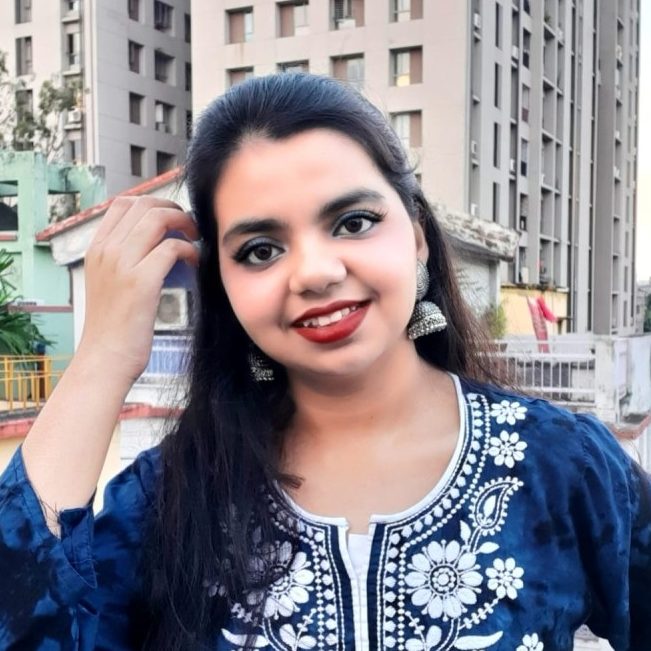
Sambrita Saha is a Kolkata-based student of food science who writes about feminism, culture and everyday resistance. She finds stories simmering in kitchens and classrooms alike. You can find her on LinkedIn.
Lead photo: Moumita Panday
Discover more from eShe
Subscribe to get the latest posts sent to your email.
 eShe
eShe 
Balanced, evocative and insightful !
Thank you !
Prof. Sachidananda Mohanty
LikeLike