

By Manisha Sahoo
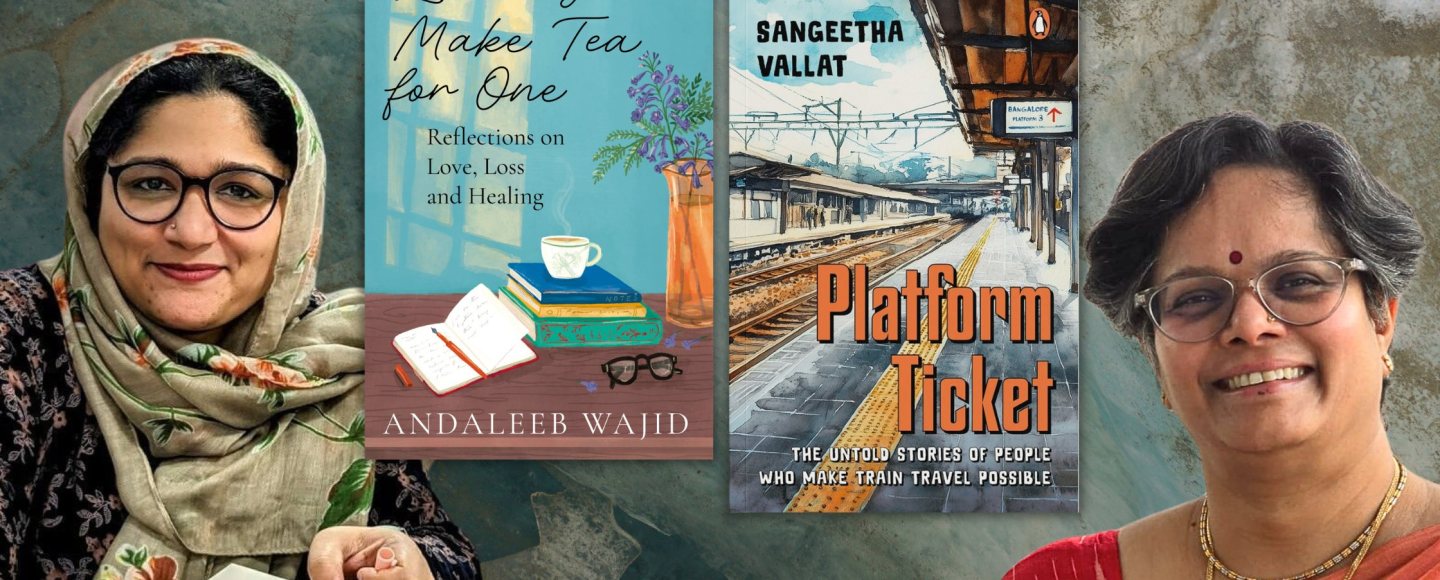
Two very different memoirs by Indian women have hit the stands recently. One is a saga of grief and healing, while the other delves into the nuances and hijinks of a railway employee’s life.
In Andaleeb Wajid’s Learning to Make Tea for One, the bestselling novelist lays bare her heart as she leads us through the double loss she experienced during Covid and how she coped with it.
Our second memoirist Sangeetha Vallat faced her own challenges coming up as one of the few female employees of Indian railways in the 1990s. She doles out anecdotes with clever language in Platform Ticket.
Besides both books being largely based in Karnataka, what they have in common is the resilience, willpower and strength displayed by the authors in every situation they faced, and the vulnerabilities they embraced to build themselves up stronger.
Learning to Make Tea for One
By Andaleeb Wajid (Speaking Tiger, INR 499)

‘I really don’t know what [strong] means but it does make me wonder what they expect me to do, if not live life each day as it comes.’
How do you deal with losing the most important persons in your life? How do you move on? Much like how love is a varied experience, loss and grief have no set rules either. In Learning to Make Tea for One, Andaleeb Wajid lays down her own experiences with love, loss and healing through the many phases of her life.
During the second wave of Covid in 2021, Andaleeb – a prolific novelist and essayist who has authored over 15 books – suffered through not only the disease but the harrowing reality of it when her husband and mother-in-law did not make it through. Hospitalised around the same time, they died within days of each other.
That experience, that grief, is unimaginable to an outsider. Andaleeb, Mansoor and Phuppujan had been a team of three for over two and a half decades, with a shared love for laughs, camaraderie and tea.
Stranded alone all of a sudden, Andaleeb has to navigate her way out of the proverbial fog threatening to thicken, for her own sake as well as for the sake of her sons. While recounting these heart-wrenching moments in short chapters, the author chronicles the days leading up to the double tragedy, meditating on the aftermath of it all in quiet reflections:
‘[The real grief] wasn’t like an all-consuming black hole but instead, it made me feel as if I’d been tied to a rocky hilltop, where waves kept crashing on me, breaking me, eroding me. And each day I had to put myself back together and go through it all over again.’

Grief of loss never leaves, but life doesn’t stop either. Andaleeb, while detailing her emotions, makes it a point to remind the reader that even in the bleakest of moments, it’s important to keep your senses. It’s okay to break down, it’s okay to feel for days that the world as you know it has ended, it’s okay to linger in the sorrow. It’s okay, still, to pick yourself up and restart.
Everybody copes and heals differently, and Andaleeb’s way to do it is to write novels, be there for her sons, cry when alone, and crochet. As she reveals her lived experiences in these pages, we meet different facets of Andaleeb Wajid, resilient and resourceful, the most inspiring of which is her journey as a writer even while wading through murky waters.
Her honest recounting of loss, not just of Mansoor and Phuppujan, but also of her father from when she was quite young, is a reassuring hug in words. The memoir often gives the feeling of sitting across from a dear friend in a quiet corner of a café and listening to their story with rapt attention. Sometimes you just want to reach across and comfort them.
I read Learning to Make Tea for One over the course of several days. For a 230-page book, that was admittedly a long time, but I needed breaks in between. The emotions got to me, and the same emotions brought me back to it.
Andaleeb doesn’t dwell on the heavier side of things for long, often recounting happier days along the way, the memories that made the relationships dearer. Her inner strength seeps into her words, not only in the way she dealt with the pain in real time, but also in the way she never gives up.
Platform Ticket
By Sangeetha Vallat (Penguin India, INR 399)

‘I gazed at the blue skies, the long winding tracks, the white-and-red semaphore, and a colossal peepul tree where the platform tapered and ended. This was my station.’
Powered by impeccable wit and humour, Sangeetha Vallat’s Platform Ticket captures the lives of Indian railway employees, the ones who kept the system running smoothly even before the time of online reservations. The book opens with an intrigue, an enquiry committee sitting down to question Sangeetha, and nosedives straightaway into how her journey began.
This former railway employee’s memoir introduces readers to the faces framed behind the glass panels of ticketing booths. Beyond the veil of dealing with long queues and often draining personalities of customers, the souls issuing the tickets are as human as the rest of us.
Added to this is the nostalgia of 1990s railway stations and train travels. Having grown up in that era, I found myself nodding along with the author at some points:
‘Ah, I miss those weighing machines in the platforms that added in fortune telling along with the kilograms…’
Sangeetha has laid down the intersectional tracks of personal and professional in sparkling prose. As varied as her postings and duties were, the people she met and befriended along the way were as diverse and unique as well. Sangeetha focuses not only on the stories of her coworkers within the same station at each step, but also of her batchmates with whom she trained at the start of her career.
The memoir, despite being packed with railway jargon, hits all the emotional beats with ease. The devil is in the details and Sangeetha often grabs it by the horns. Her enthusiasm and love for the job, as well as those surrounding her, spring from the pages and warm one’s heart.

From happy, hilarious stints to downright gruesome accidents, Sangeetha does not hold back on the nitty-gritty of a railway employee’s life. We learn not only of the duties a ‘commercial clerk’, parcelling officer and TTE are expected to fulfill, but also of the exceptional grit undertaken in unprecedented circumstances, such as bloodcurdling deaths on railway tracks.
Being one of the few female recruits in the 1990s, Sangeetha also details the disparity faced by women in the workforce. Some, like the author herself, were adored by their supervisors in their green days and trained with care. Others had it hard from the very start, beginning with family opposition to their education and employment.
Platform Ticket trundles through every aspect of life – the workplace, families, homes, romances, politics, sisterhoods and brotherhoods, and lifelong friendships.
The last few pages, which bring about the conclusion of the opening intrigue, rush past faster than the Shatabdi, but the train ride all along is worth a read. The best part through the entire saga is the chirpy, can-do-it-all persona at the centre of it all – the storyteller.
Sangeetha Vallat wields her expertise in both railways and writing to bring forth a memoir that is as informational as it is heartwarming, humane and hilarious.

Manisha Sahoo has a Bachelor’s degree in Engineering and a Master’s in English. Based in Bhubaneswar, she’s a full-time writer, currently querying a fantasy novel, and a professional manuscript evaluator. Her words have appeared in several literary magazines and anthologies. Follow her on Instagram, X and Substack.
Discover more from eShe
Subscribe to get the latest posts sent to your email.
 eShe
eShe 
Loved the review! Will pick these up, soon
LikeLiked by 1 person