
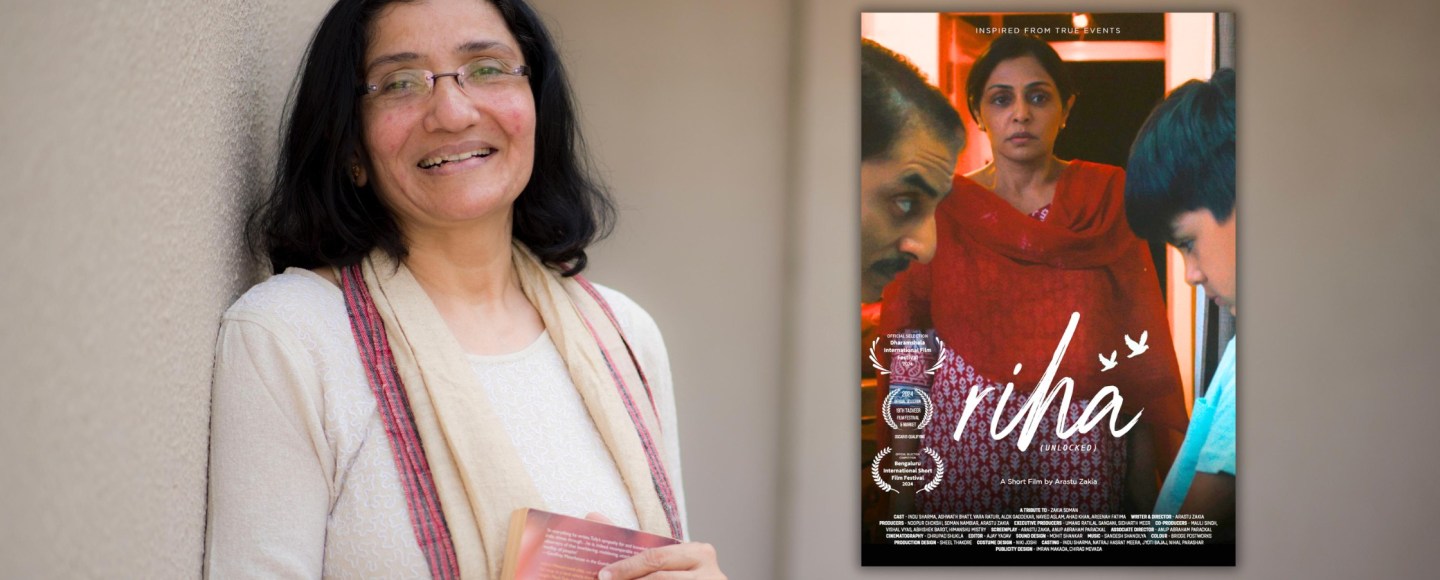

What does it take for a Muslim woman in Gujarat to not only rise up against domestic violence in her own home but also fight for the fundamental rights of other women in her community? At a time when political leaders in India are stoking majoritarianism and the harassment of minorities, especially Muslims, battling legal and political systems is a double jeopardy for Muslim women fighting patriarchal injustices in their communities.
Women’s rights activist and author Zakia Soman, cofounder of the NGO Bharatiya Muslim Mahila Andolan, has been at the forefront of the relentless struggle for the rights of Muslim women in India. Born in Ahmedabad, Gujarat, she gave up her job as a university professor and began working for minority rights after dispossessed Muslim women repeatedly reached out to her for help in matters of domestic violence and divorce through triple talaq.
She was one of the co-petitioners in a protracted legal battle that finally led to the abolishment of instant triple talaq by the Supreme Court of India in 2017. And she continues to fight against the practice of polygamy that denies Muslim women their marital rights.
Now, her filmmaker son Arastu Zakia has released a 30-minute short feature film Riha (‘Unlocked’) based on his mother’s life, including her experience of domestic abuse. The film is being screened at the prestigious Tasveer Film Festival 2024, the world’s only Oscar-qualifying South Asian film festival.
eShe editor Aekta Kapoor was invited by Tasveer to interview Zakia and Arastu as part of the virtual segment of the film festival (October 21 – 31, 2024). Here are excerpts from the conversation, edited for length and clarity.
Aekta Kapoor: Riha depicts an episode when a Muslim activist helps another Muslim woman whose husband has given her triple talaq. Was this inspired by your own life and the legal battle to abolish triple talaq in India?
Zakia Soman: Yes, it is very much my personal story. I didn’t start out as an activist. It was only when women began coming to me with their issues, their need for freedom, and their quest for equality that I transformed. Meeting and interacting with them made me an activist. I owe a lot to these women—survivors of the Gujarat riots and others who faced injustice in their families due to the violations in Muslim personal law.
These women’s bravery, despite coming from such deprived backgrounds, inspired me. This journey made me reflect on my own life, my difficult relationship that lacked love and was abusive. Seeing these women gave me no excuse to continue in that kind of life.
In South Asia, marriage is a deeply traditional institution, where wives are often considered second-class. Most wives, unfortunately, accept this role. But when subjugation becomes so intense, it can destroy one’s humanity, and even children are not spared from emotional or physical abuse.
Witnessing women like Aisha, a character in the film, opened my eyes. I have met hundreds, even thousands, of women who come from economically marginalised backgrounds, yet they stand up and break their silence. It made me realise I was small in comparison if I continued to keep quiet and compromise with my circumstances for the sake of maintaining an illusion of a ‘happy family’.
Justice doesn’t come without a fight. In our society, culture, tradition, and even religion often enforce silence, expecting us to accept whatever is done to us. It took me 16 long years to break free from that cycle—the prime of my life. And for Arastu, it meant an entire childhood spent in that kind of environment.

Aekta: Arastu, your name is actually the South Asian version of Aristotle, which says a lot about your mother, who named you. You’ve also adopted your mother’s surname, which involved a lengthy legal process. Could you tell us about the moment you decided to make a film based on your mother’s life?
Arastu Zakia: As the film shows, growing up in an extremely constrained, prison-like place we called ‘home’, I had very few windows into the outside world. My mother was my only friend, and the television was basically my only view beyond our walls.
Back then in the nineties, Indian TV was largely ruled by Dharma Productions and Yash Raj films. As unrealistic or fantastical as those films might have been, they taught me there was another way of life, a world of beauty and a life without violence. This expanded my sense of hope, and I think that’s when the seeds of wanting to create something took root.
I’d often tell friends that I was going to make a film someday. It took years to feel ready to tackle this project psychologically, to get my hands dirty with the work. But ever since I entered filmmaking, I knew my first story had to be this one because it’s such a huge part of my life.
Growing up in that environment is something I can never fully leave behind. This film was something I had to create to clear the way for other stories. Everything about who I am today comes from that time—good, bad, and ugly. It was painful, but now it’s fuel.
I couldn’t have told this story without making it a tribute to my mother. She’s the reason we’re no longer in that situation. It’s not that our experience was unique or that violence in homes is rare; it’s more about different degrees. Unlike many, we had someone who took the lead to change things, and that had to be in the film.
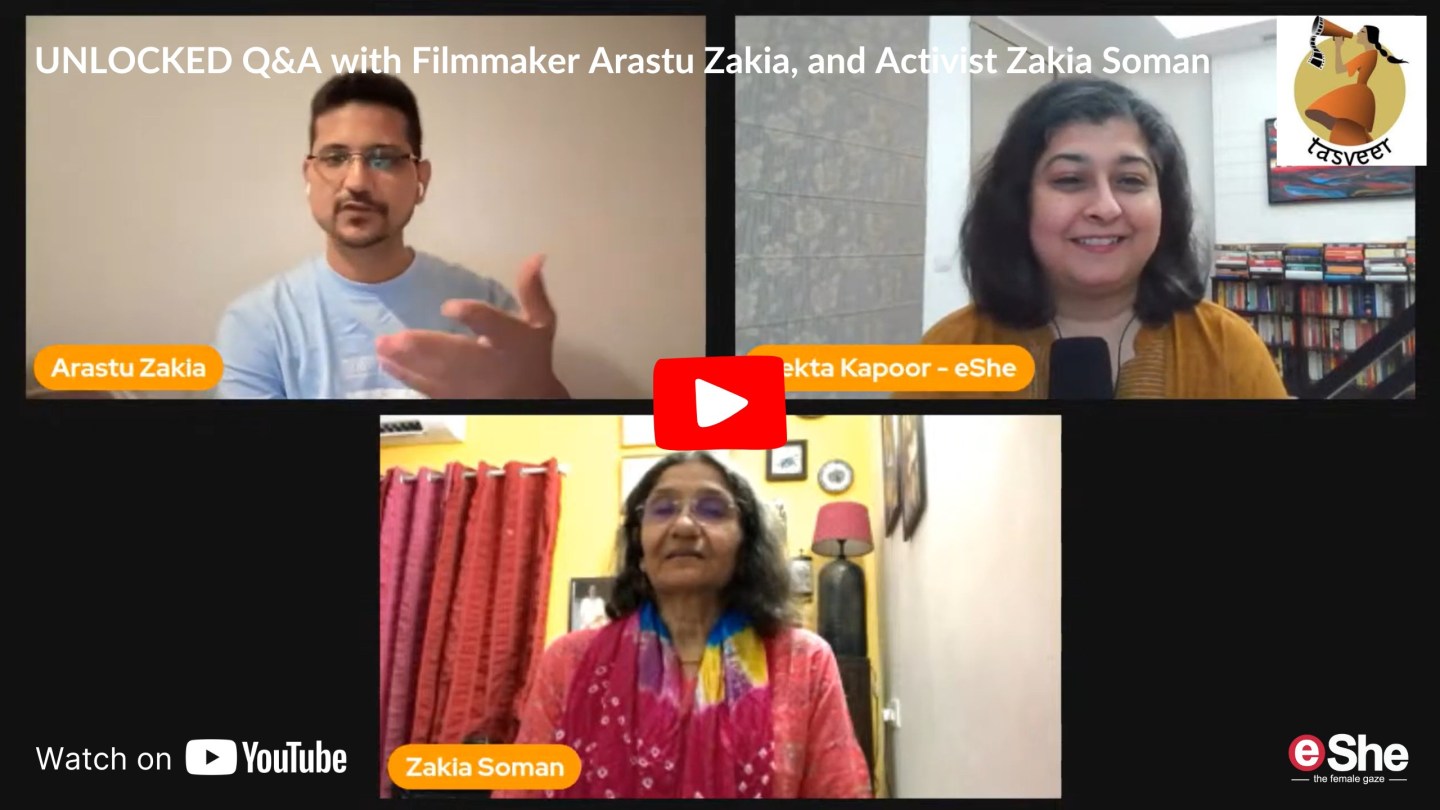
Aekta: Zakia, in one of your talks, you spoke about how religious custodians often collude with politicians to uphold patriarchal codes. You’ve also mentioned how ordinary Muslim women are bravely standing up against these powerful forces. It’s hard to imagine the difficulty of facing both gender injustice within one’s community and patriarchal legal-political systems on a larger scale. So, what does it take to keep up this kind of battle, and how can the rest of us support you?
Zakia: That’s a very important question. One thing that’s essential is breaking the myths that have been perpetuated in the name of religion. Islam is a religion of gender justice and equality, but this fact has not been emphasised by religious or social leaders—or even within families.
When you look at the status of women in our society, there’s an underlying belief that a woman must always play a dependent role: first, as an obedient daughter, where her father and brothers are regarded as her primary support; then, as a wife who depends on her husband and in-laws; and later in life, as a mother relying on her sons. This narrative has been constructed, and it’s not just a Muslim issue—it reflects our overall patriarchal and misogynistic society, regardless of faith.
Within the Muslim community, however, one issue is the lack of reformed and codified Muslim family laws. Because of this, Muslim women face legal discrimination.
Hindu and Christian women, for example, enjoy protections in areas like marriage, divorce, property, child custody, and guardianship under laws passed by the Indian Parliament—laws that recognise and uphold women’s rights. But for Muslim women, the largest minority, these reforms haven’t happened.
After Independence and the traumatic violence of Partition, there was a reluctance, or perhaps even an excuse, to avoid touching Muslim personal laws. Every time there’s talk of reform, the religious leadership argues that it’s interference in their faith.
The rise of majoritarianism and Hindu nationalism has added to this tension, further marginalising the Muslim community. The Muslim woman, as part of that community, doesn’t stand alone in these challenges—her struggles are tied to the family and community as a whole.
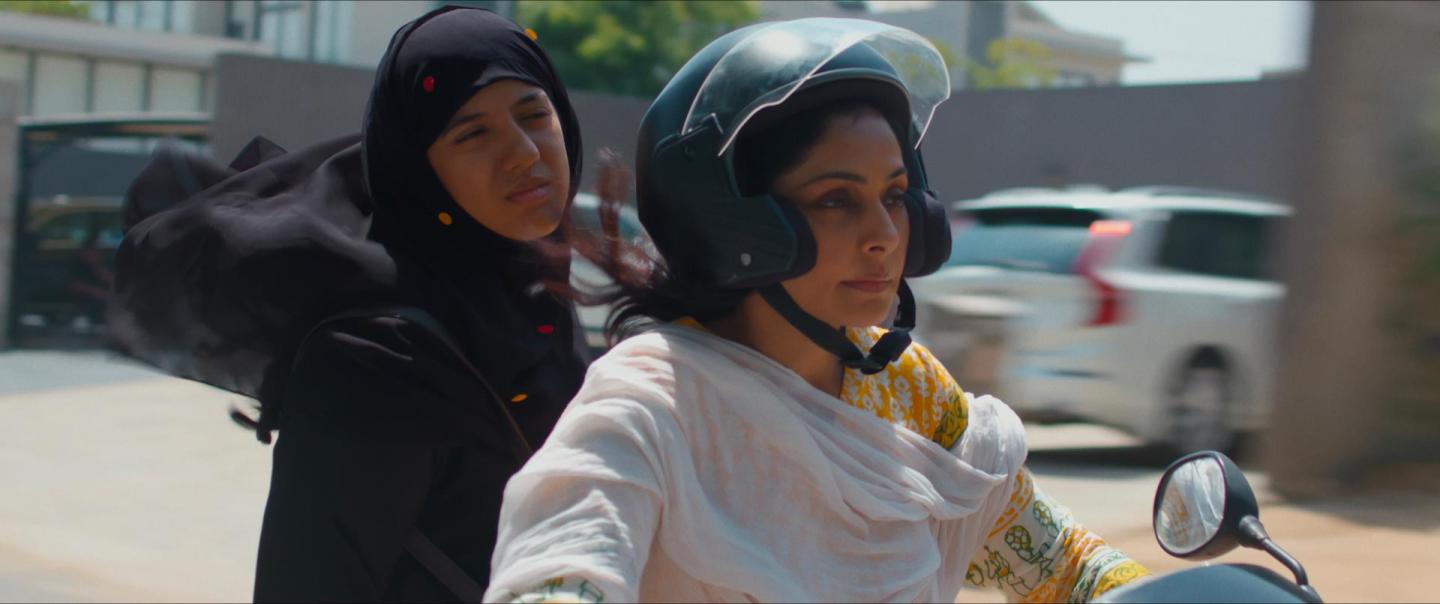
By platforming a film like Riha, Tasveer is helping to raise awareness, educate, and spread the message that Muslim women, like all women, are fighting for justice. And they have the right to justice, not only within the Quranic framework but also as citizens of India, entitled to legal justice and equality in family matters.
Tasveer’s platform allows more people to see the film, learn about these issues, and understand that support for Muslim women’s rights is part of the larger fight for gender justice.
There’s much work still to do, and it requires an ongoing effort at multiple levels—civil society, feminist activists, decision-makers, artists, journalists—all need to be involved. It’s a campaign, much like the one during the movement against instant triple talaq, which garnered support across the country.
Aekta: You mentioned you’re fighting for affirmative action for women’s rights as outlined in the Quran to become translated into law in India. What is your aim in pursuing this approach? Isn’t it counterproductive to rely on religion for women’s rights? Why ask for this rather than, say, advocating for a secular law to protect all women, regardless of religion?
Zakia: Ideally, a secular law would be best. However, we’re far from that reality. There’s talk about a uniform civil code, but it’s now politicised.
We must also remember that ordinary women are believers too. They hold the faith that their Allah created them as equals to men, and they believe Allah does not discriminate against them.
Our Constitution is unique in that it upholds secularism while also protecting citizens’ religious freedom. Women are entitled to justice both from within their religion and as citizens. They should be able to benefit from both sources, but patriarchy and politics have denied them justice on both fronts.
For many Muslim women, who are economically, socially, and educationally disadvantaged, often all they have to rely on is their Allah. My secularism and my feminism both tell me to respect that. Our Constitution has already given them these rights, so who are we to intervene or take them away?
Of course, a secular law for all would be ideal, but I don’t see it happening, at least in my lifetime.

Arastu: There’s a moment in the film where Aisha describes her story. She talks about being given triple talaq, thrown out of her home, with everything—including her daughter—taken from her. She says, “But God is on my side,” and that sentiment is common.
I’ve heard it time and again from women. For many ordinary Muslim women, their relationship with God is deeply personal and spiritual, not necessarily aligned with how others interpret it.
Even if a religious leader claims that God has ordained a certain hardship for them, they will often say, “No, my God would never want this for me.” It’s a unique perspective and language, one I haven’t seen from other socioeconomic groups, and that perspective had to be part of the film.
Aekta: There was this very palpable sense of domestic violence in the film, an underlying sense of threat, even though there was no violence shown explicitly. I was interested in knowing your thought process as a filmmaker and as a son who deeply loves and respects his mother. How did you balance between the creative and the personal?
Arastu: I credit my mother for this; she never burdened me with having to balance anything. Whether it has been this film or any previous attempt at expressing this part of our lives, she always told me, “Don’t worry, say what you want. You don’t have to ask me. Say what you feel.” Starting with that sense of freedom, I didn’t feel burdened.
My preference as a filmmaker is not to tell a black-and-white story. It’s not to have a hero whose every action is justified and a villain who’s unequivocally wrong. In fact, one of the most interesting parts of telling the story was putting myself in the place of the perpetrator and imagining why these things might have been done, trying to humanise that character and see beyond the black and white of it. That’s a deeply therapeutic, cathartic, and tumultuous process to go through, whether you’re a filmmaker or not.
Regarding the depiction of domestic violence, people who’ve been in those situations can attest that it’s not just about those specific incidents of violence. Those are the parts that attract attention, but for people in those situations, it’s the remaining 364 days when you live in dread, knowing that any moment could bring that one incident of violence.
That constant sense of mental dread hurts much more than any single violent event. If I’ve managed to convey that, I believe I’ve represented domestic violence more authentically than just focusing on the dramatic peaks of a single event.

Aekta: Zakia, coming back to the second point you mentioned, in the last decade we’ve had another kind of political force in India using Islamophobia as a tool to win votes. This adds another layer of challenge for Muslim women. Their battle for gender justice is used as a political ploy by those propagating hatred against Muslims. If a Muslim woman steps up to challenge patriarchy within her community, she risks further ostracism for ‘betraying’ her community and giving ammunition to anti-Muslim forces. What has been your experience with this in the last 10 years?
Zakia: We were able to build a women’s movement against triple talaq starting around 2010 and gaining momentum until we finally went to the Supreme Court in 2016. Honestly, I don’t think we could replicate that today such as on the issue of polygamy. Back then, in 2014 and 2015, during the NDA (National Democratic Alliance) government’s first term, the government supported the abolition of triple talaq in the Supreme Court, with the law ministry even filing in support. This was a welcome development.
However, as time passed, especially in the government’s second term, with discriminatory laws like the Citizenship Amendment Act, incidents of lynching, and targeting people based on religious background, it became nearly impossible to mobilise women.
Even back during the triple talaq movement, we faced criticism about speaking on Muslim women’s issues under a BJP (Bharatiya Janata Party) government. But we argued that there’s never a ‘right’ time to seek justice and equality; when the momentum is there, you seize it to make a big change, like taking the matter to the Supreme Court.
To their credit, the government did support the abolition of triple talaq, but later there were attempts to appropriate the movement and take credit for it. That credit belongs to ordinary women, to all the women of India—including non-Muslim women in media, the judiciary, and academia—who supported the cause and made this change possible.


The unfortunate part is that the so-called secular parties, especially the Congress Party, remained silent. Even today, years after the Supreme Court abolished triple talaq in 2017, we still don’t know the official position of the Congress Party on the issue. By choosing to stay silent on matters of faith within minority communities, these secular parties made it easy for the BJP and its allies to claim credit for the reform.
Today, with the increased marginalisation and onslaught on the Muslim community—bulldozer actions, restrictions on hijab, and targeting of namaz and azaan—I don’t think it’s possible to build a movement like that again. Though the petition against polygamy is already in the Supreme Court, I can’t see a movement forming around it today because of the level of hostility the community is facing, coupled with the impunity of those who openly call for the genocide of Muslims.
The rhetoric has escalated from “go to Pakistan” to outright calls for annihilation. What’s happening in Gaza is being celebrated by some Hindu supporters in India, who, driven by a deeply flawed understanding of Islam, blindly support Israel just because they see it as an anti-Muslim stance. This myopic view runs counter to India’s tradition of pluralism and inclusivity. Unfortunately, this vitiated political environment is affecting everyone, especially Muslim women, who pay the highest price.
Women are half of India, and they are very enthusiastic voters. Often, the percentage of women voters is higher. Yet we’re so marginalized, and it seems no one cares what happens to us. We’re not seen as a unified block, and we’re divided into so many segments. So, it’s unfortunate. Then we have the clergy, which is hopelessly steeped in misogyny, patriarchy, conservatism, and medieval mindsets.
That’s precisely why we need the Constitution, laws, and the Parliament. But when there’s this level of polarisation, even within the Parliament, what can we do? It’s not a good time in that sense.
About Tasveer Film Festival:
Founded by Rita Meher and Farah Nousheen soon after 9/11, Tasveer Film Festival, which is based in Seattle, USA, provides a platform for South Asian filmmakers to share their work with a global audience and fosters connections between filmmakers, industry professionals, and film enthusiasts.
Beyond the film festival, Tasveer also organises various events and workshops throughout the year, including panel discussions, masterclasses, and community screenings. These initiatives aim to educate and inspire audiences about South Asian culture and cinema.
Discover more from eShe
Subscribe to get the latest posts sent to your email.
 eShe
eShe 
EXCELLENT!!
LikeLike