


By Komal Malhotra
Some books come into your life not to instruct, but to awaken. This Book Won’t Teach You Parenting: But It Will Make You a Better Parent (Penguin India, ₹499) is one such powerful read. Written by psychotherapist Riri G. Trivedi and parent educator Anagha Nagpal, this isn’t your average parenting manual filled with quick-fix solutions.
Instead, it is a deeply researched, heartfelt invitation for parents to examine their inner worlds, so they can raise emotionally healthy children without unconsciously passing on their own unresolved wounds.
The book opens with one of my favourite quotes by Kahlil Gibran: “Your children are not your children…” – a gentle reminder that parenting is not about possession but presence. It beautifully sets the tone for the pages that follow, urging us to reflect not just on how we raise our children, but why we do it the way we do.
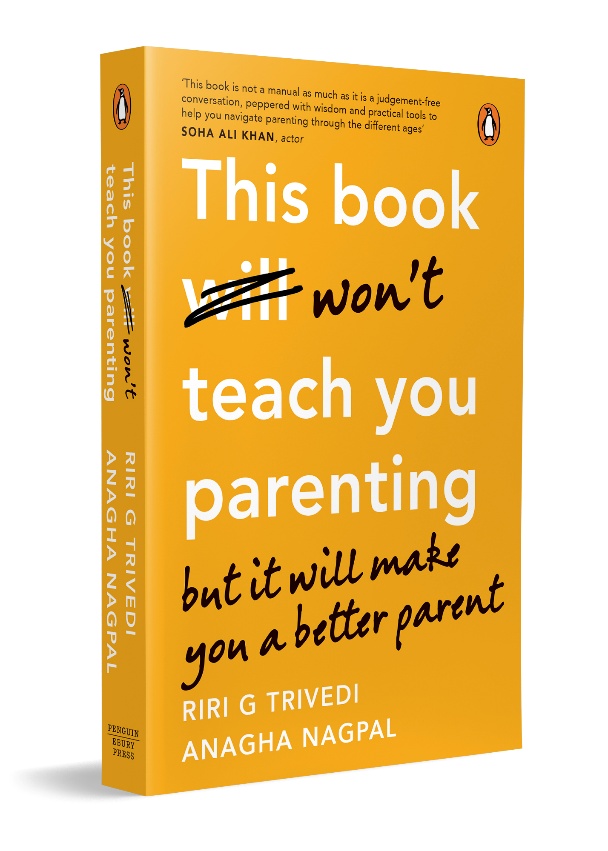
A research-based journey through conscious parenting
At its core, this book is a research work grounded in the study of Adverse Childhood Experiences (ACEs), trauma-informed approaches and psychology. The authors shed light on how patterns from our past – often invisible – can shape the way we respond to our children.
The introductory section is especially effective in setting expectations – it clearly outlines what the book is about, why it was written and where parents might find themselves in its pages. This clarity is refreshing in a genre that can often feel either too preachy or too clinical.
For example, the authors write:
“Adopting a problem-solving approach can work very well with young kids. Instead of blaming your child, such as ‘You always watch so much TV’, or ‘This is why you aren’t doing well at school’, try to make your child also realize that there is an issue that both of you can work together to fix.“
Each chapter explores an important theme: parenting styles, attachment, self-regulation, nervous system responses like fight-or-flight, and how to connect rather than control. At the end of every chapter, readers are guided with thought-provoking self-reflection questions to better understand their own childhood and reactions. This reflective format transforms the book into more than just a read – it becomes an experience.
Practical tools that stand out
What I especially appreciated were the charts and visual aids peppered throughout the book.
From age-wise screen time recommendations to independence readiness charts and tools to help children label and express their emotions, these resources are practical, easy to refer back to, and serve as quick guides for overwhelmed parents.
These inclusions lighten the otherwise dense content and offer actionable takeaways, which I think many parents will find useful.


When truth becomes a tough read
That said, while the real-life examples throughout the book add depth and emotional gravity, they can at times feel overwhelming. Many stories touch upon trauma, neglect and difficult childhoods. Though these accounts are important and undeniably true, reading them back-to-back can feel emotionally exhausting – almost like watching a documentary filled with intense scenes, one after another.
And here lies my only real critique: the book, while rich in research and deeply sincere, may feel too intense or academically inclined for the lay reader hoping for a simple, relatable conversation that meets them where they are. For those already stretched thin – emotionally and mentally – the tone may come across as a bit heavy and less accessible.
This doesn’t take away from the importance of the content – it just makes me wish that the powerful insights within were presented in a slightly more approachable, emotionally paced manner for a wider audience.
Self-care and healing at the core
Despite this, the book ends on a hopeful and much-needed note: self-care and self-regulation for parents. In a world where parents are constantly encouraged to “do more”, it’s refreshing to read that one of the most important things we can do for our children is to heal ourselves. The authors gently remind us that parenting isn’t about perfection – it’s about presence, repair and emotional attunement:
“It is important to note that, as parents, we are constantly learning, making mistakes, correcting them and relearning, just like our children.”
This book isn’t a parenting manual; it’s a mirror. It doesn’t give you scripts or superficial strategies. Instead, it offers you something far more lasting: awareness, reflection and the invitation to pause and grow.
While its research-heavy approach may feel a bit intense for some, it is a must-read for parents who are ready to break generational cycles and raise children with intention and empathy. It may not be a breezy read, but it is a necessary one. If you’re a parent willing to look inward, ask hard questions and embrace change, this book will inform and even transform you.

Komal Malhotra is a children’s author, storyteller and educator on a mission to make learning exciting. She is the founder of Magic StoryTime and works in content and curriculum development at Global Schools Group. You can find her on LinkedIn and Instagram.
Discover more from eShe
Subscribe to get the latest posts sent to your email.
 eShe
eShe 
Pingback: A Mirror for Parents: eShe Praises the Emotional Depth of Riri Trivedi and Anagha Nagpal’s Transformative Book on Indian Parenting - Wellness Space