


By Neer Bukharia
“I’m looking for love. Real love. Ridiculous, inconvenient, consuming, can’t-live-without-each-other love.” That bit of soapy dialogue by Carrie Bradshaw became a mantra for an entire generation. When Sex and the City hit American small screens in 1998, it was a glittery cultural phenomenon. And even now, the show holds strong on streaming platforms far away in small towns in India, still raking in viewers who want a slice of that Manhattan magic.
But does it still hit the same for Gen Z as it did for Gex X and millennials? I’d argue – not quite.
The show follows four single women in their 30s living their best lives in New York City – all with enviable careers, endless wardrobes, and an exhausting number of ‘eligible’ men circling them like bees. Each woman is waiting for her fairy-tale love story while dabbling in steamy flings and casual dalliances in the meantime.
All the rage in its time, the show popularised the ‘girl boss’ – a woman who drinks, dates, earns and orgasms on her own terms. But the message? You can be powerful, independent – and still incomplete without a man. (Cringe.)

Carrie, the protagonist and narrator, writes a column called ‘Sex and the City’ (which gives the show its name). Through her musings, we’re given a front-row seat to the romantic chaos of four women trying to ‘have it all’. There’s desire, heartbreak and philosophical debate over coffee about whether soulmates really exist.
It’s breezy, it’s witty, it’s undeniably addictive – until you start to see the pattern.
Episode after episode, Carrie somehow ends up with the cherry on the cake: the sweethearts, the swoon-worthy story arcs. Meanwhile, her friend Samantha – the wealthy owner of a PR company – has to represent the ‘sex’ in Sex and the City, showing up scene after intimate scene wearing little more than a confident smile and a silk sheet.
At first glance, Samantha seems the epitome of bold womanhood – confidently owning her sexual pleasure. But soon, the portrayal feels less empowering and more… pushy. The intention may have been to depict a woman refusing to conform to monogamy – hurrah? – but the execution is a repetitive, outdated storyline centred on one-night stands and a seemingly never-ending quest for orgasmic bliss.

This is a show that once felt revolutionary. But for Gen-Z – a generation raised on conversations about intersectionality, consent and the politics of desire – it raises more questions than it answers.
Yes, we understand that women’s sexual pleasure matters. But is this really the way to champion it? Is the show about sexual agency or the hypersexualisation of single women? Are we still equating empowerment with the number of men a woman has bedded? Can we not talk about women’s sexuality without sexualising them?
The character of Samantha bears the brunt of keeping the show’s sexual steam alive. She’s a fan favourite and a feminist enigma. The show itself is a cultural landmark. But watched through a Gen-Z feminist lens, it feels like a glittery bubble floating far above reality – catering almost exclusively to white, upper-class, financially secure women. It maintains strict bourgeois boundaries while championing inclusivity. Ironic, isn’t it?

When it comes to themes like homosexuality, intersectionality and marriage, the show dances on very thin ice. It scoffs at the ‘patriarchal institution’ of marriage, only to romanticise a grand, heterosexual, monogamous love story.
To disrupt the heteronormative reverie, Samantha has a brief lesbian fling – and just like that, the show ticks the diversity box. Oh, and let’s not forget Stanford Blatch – the token gay friend, there for a sprinkle of rainbow flavour. While female friendship is the one real gem I appreciated in the show, even that exists in a world startlingly homogenous and exclusive.
Beneath the glamour lies a faint gleam of white supremacy, and the reductive portrayal of sex as liberation, liberation as sex, and sex meaning… men. The contradiction? The show urges women to embrace their sexuality, yet constantly places that sexuality in service of male attention.
Radical feminists like Shulamith Firestone once railed against the portrayal of women as sexual objects – but here we are, half a century later, still grappling with the same dilemma. Samantha’s character makes us ask: how should we represent women’s sexual agency in the media? Must it always be porn-adjacent to count as ‘liberated’?
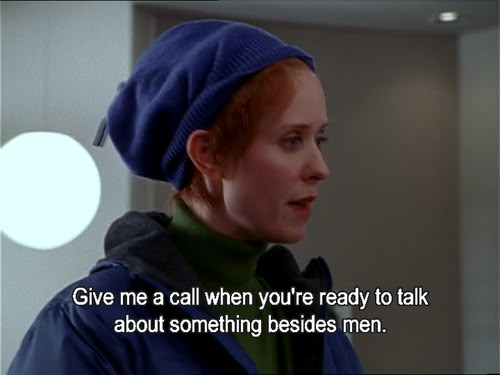
On one side, liberal feminists champion bodily autonomy and sexual freedom. On the other, radical thinkers argue that this endless sexualised imagery in pop culture is just another patriarchal trick – a portrayal of women’s ‘independence’ designed for the male gaze.
To me, Sex and the City is bourgeois feminism in designer drag. It said something bold about women’s sexuality in its time but watching it now, I cannot help notice its glaring lack of diversity, the clumsy cultural appropriation, and the invisibilisation of marginalised narratives.
Where were the single mums dating in ’90s New York? Where were the non-white women – as leads, not caricatures or sex workers? Did they not exist in this cosmopolitan playground of sexual awakening?
Miranda, a successful lawyer, is perpetually baffled by relationships despite her sharp understanding of constructed gender identities. Charlotte is caught in a pastel-hued purgatory – a ‘sweet girl’ longing for traditional love and marriage. Carrie – a talented writer – remains indecisive and ends up chasing men like she’s chasing column deadlines. Samantha, a powerhouse, is reduced to sex on legs – performative climaxes her only form of excellence.

It’s almost stunning how thoroughly their careers are sidelined in favour of their sexual adventures. The actors did their best, but they were stuck in scripts soaked in patriarchy, delivering a vision of womanhood and femininity that conflated autonomy with exhibitionism. Bold characters that still silently submitted to the androcentric view of female sexuality.
In the end, the show embodies the exact version of women’s empowerment that feminists from the Global South have long sought to challenge. With definitions of feminism shifting, is Sex and the City relevant for a new generation confronting white supremacy and heteronormativity while demanding inclusion?
As an Indian Gen Z-er myself, I’d say we must acknowledge the show’s historical impact, but does that mean we gloss over its missteps? Isn’t that a little disrespectful to the movement itself?
No doubt Sex and the City remains a show that brought women together, and let them talk openly about sex and pleasure. But let’s not pretend it gave all women that stage – it gave wealthy white women that stage. It shattered some taboos, sure – and opened the door for sexualities to be discussed in mainstream media. That counts for something. But it’s a legacy of duality: significant and yet deeply flawed. Important, yet problematic.
To go back to my question, is the show still binge-worthy and relevant for Gen-Z?
Yes, the show still has value. There’s a sense of sisterhood, even in its exclusivity. It’s iconic, even with its absurdities and cultural blind spots. It’s a good starting point for understanding where media feminism has come from – but not where we should be heading.
Yes, it’s worth a watch – if only to remind ourselves that female sexual agency and empowerment do not require the hypersexualisation of women.

Neer Bukharia is a literary enthusiast and an MA Gender Studies student at Dr BR Ambedkar University, Delhi. She is a commercial webpage writer, ghostwriter and freelance junior editor. In her free time, she reviews books and follows internet trends.
Discover more from eShe
Subscribe to get the latest posts sent to your email.
 eShe
eShe 
Sex is a very strong urge which cannot be snubbed in any way. So it must be fulfilled while mating 2 people without any hinderance. Sex is like an appetite without which we cannot survive!!
LikeLike
Thank you for this brilliant piece!
Completely agree with the conclusion.
Congratulations!
Prof. Sachidananda Mohanty
LikeLike