
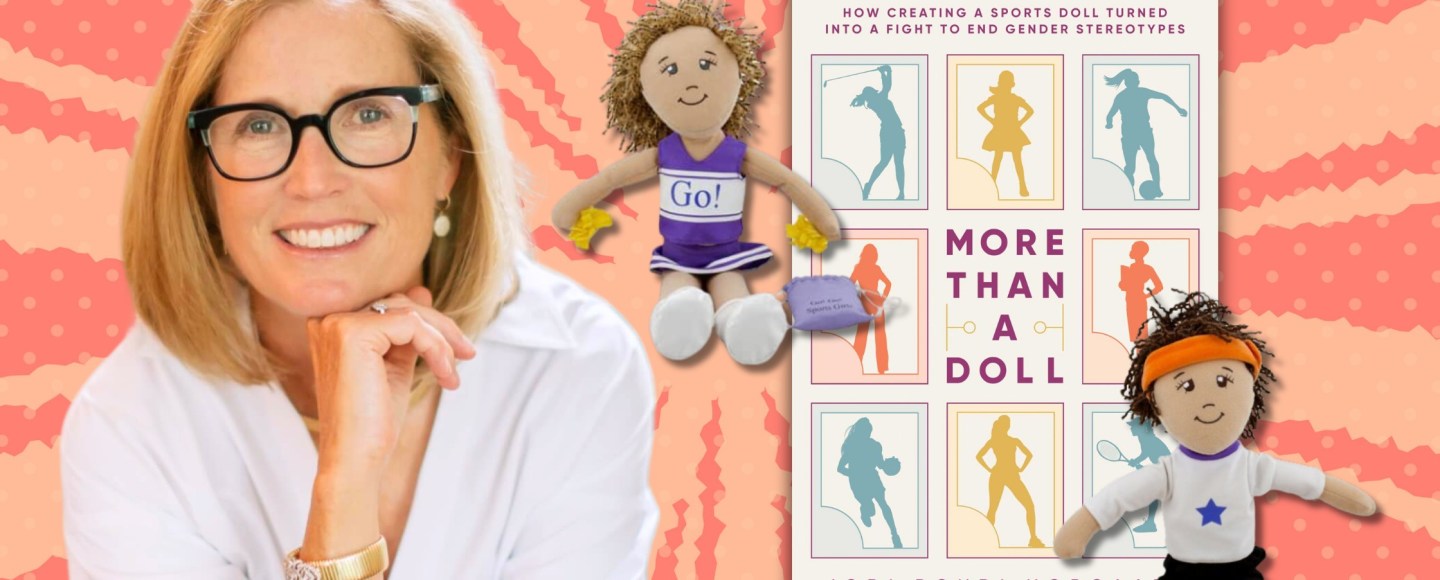

American entrepreneur Jodi Bondi Norgaard set out to challenge gender norms in the toy industry with a sports doll aimed at athletic, adventurous girls – such as her own daughter. But her mission quickly faced resistance from a culture rooted in traditional gender roles – even when it comes to toys.
In her new book More Than a Doll (Post Hill Press, INR 1144), Norgaard argues that gender inequality doesn’t start in adolescence – it begins in early childhood, through toys (especially sexualised dolls), books, and screen games that subtly, but powerfully, shape lifelong perceptions.
Norgaard’s work as creator of the award-winning Go! Go! Sports Girls dolls has placed her at the forefront of a movement to dismantle gender stereotypes in toys and media. A recognised thought leader in the toy industry, she champions active, healthy play for girls over traditional beauty-focused messaging.
Norgaard collaborated with the White House Gender Policy Council and contributed to national discussions on gender equity in children’s content. In 2023, she partnered with the Geena Davis Institute on a landmark report examining stereotypes in toy advertising and marketing.
This excerpt from her new book is published with permission from Post Hill Press.

By Jodi Bondi Norgaard
Some people have an “aha moment” in glamorous places – while summiting a mountain or walking alone at sunset on a deserted beach. Others find clarity while mediating or practising mindfulness. Me? My moment of clarity? The time when I said, I see a problem, there must be a better way, and I can be the one to fix it… happened at a toy store. Not quite as glamorous, but it does go to show that inspiration lies in unexpected places.
Here’s what happened that summer day in 2006. If you are a parent, you will be familiar with this scene: You are running into the toy store with your child because she needs a wrapped birthday gift for a party that she is attending in 30 minutes! That was me with my nine-year-old daughter, Grace. Her scrubbed face pink from exertion from soccer practice, hair in messy pigtails, shin guards still on, running behind me pointing out toys she liked.
We were quickly moving through the aisles when a line of dolls grabbed my attention. They were dressed in belly-baring clothing, high heels and makeup. I picked up one of the dolls, and the name on the hangtag was “Lovely Lola”. I started to pick up other dolls in the line, and there was “Dazzlin’ Destiny”, “Cute Candy” and “Sizzlin’ Sue” to name a few.
I was out of my mind! I thought to myself, What in the world are we marketing to girls? These dolls look like hookers! At that moment, I knew there wasn’t one parent who wanted their daughter to look, act or be called “Lovely Lola”, “Dazzlin’ Destiny”, “Cute Candy” or “Sizzlin’ Sue”.
I bought “Lovely Lola” while scolding the salespeople in the toy store as my daughter ran behind me asking, “Mom, is that the birthday gift for Maddie?” I said, “No, I am buying it to show Dad,” which confused her even more.
This encounter with Lovely Lola crystallised something I already knew. Our culture, specifically the toy industry, was doing a lousy job providing girls with strong, smart, and powerful images. Maybe I couldn’t change an entire culture, but there had to be something I could do.

What had preceded this moment of clarity were layers of personal experiences with gender inequality and gender stereotyping. Gender issues had been on my radar for years, for decades, but I didn’t know what I could do personally to change it, so I pushed it aside… until I met Lola.
Lovely Lola represented all that history in a 14-inch plush doll. And that’s when I realised how I was going to deal with gender issues. Girls needed a doll that emphasised what girls’ minds and bodies can do versus what their bodies look like.
My encounter with Lovely Lola was what organisational psychologist and New York Times best-selling author Adam Grant calls a vuja de moment. Vuja de is the reverse of déjà vu. “We face something familiar, but we see it with a fresh perspective that enables us to gain new insight from old problems,” Grant writes.
In his book Originals: How Non-Conformists Move the World, he discusses how it is our nature to “rationalise the status quo as legitimate” and points out that “originality is taking the road less travelled, championing a set of novel ideas that go against the grain but ultimately make things better.” Basically, challenging the status quo.
My hero for challenging the status quo on gender equality is Billie Jean King. When I was nine years old – the same age as Grace when we discovered Lovely Lola – I fell in love with tennis and idolised Billie Jean King. It was the era of fierce female tennis players: Chris Evert, Martina Navratilova, Margaret Court, Virginia Wade, and Evonne Goolagong.
When I learned that Bobby Riggs, a 55-year-old man I had never heard of, had challenged my idol, the number one female tennis player in the world, who was 29, I laughed and thought he was crazy. It didn’t matter that, 30 years prior, he was one of the world’s top tennis players.
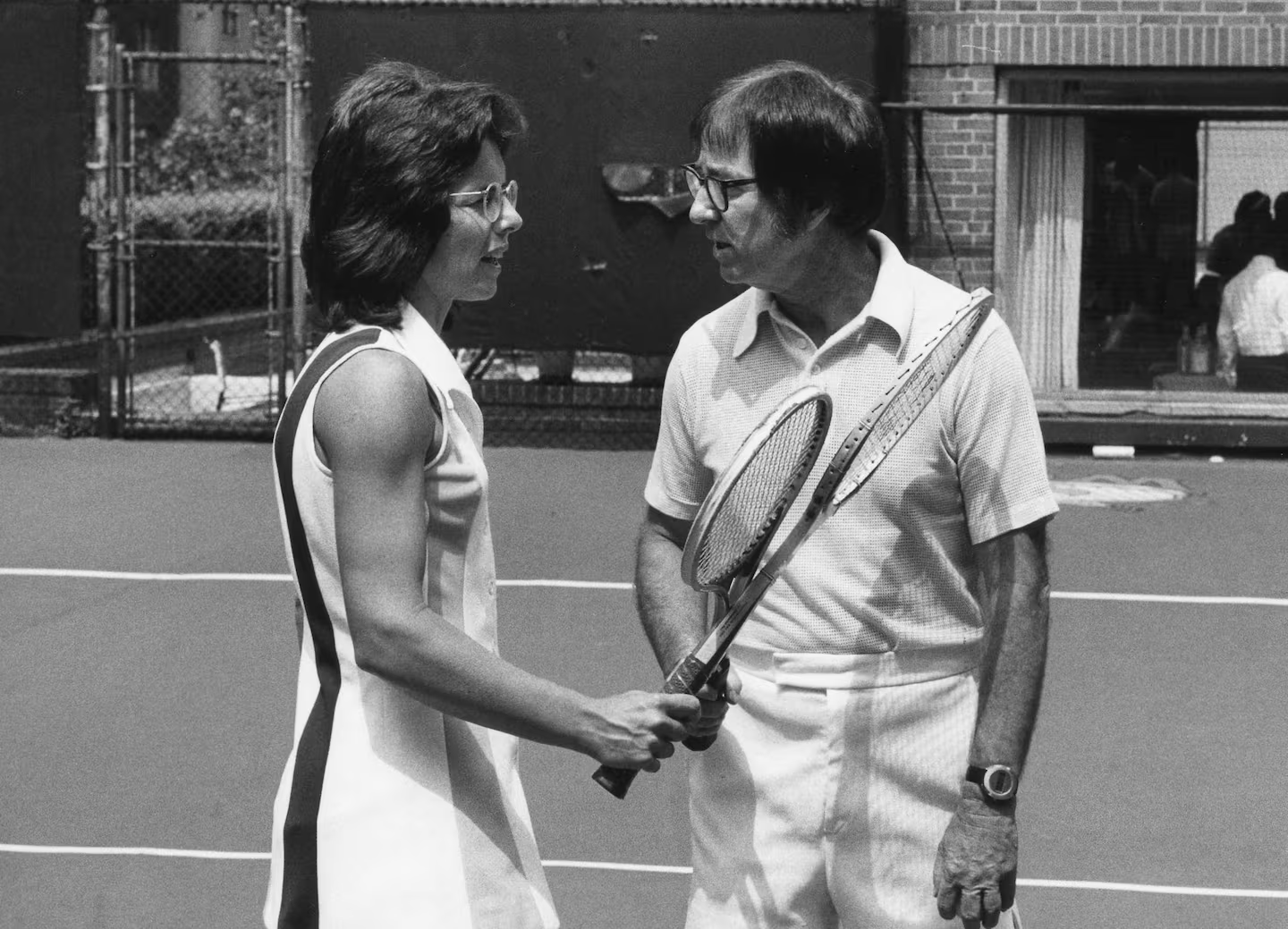
For weeks, I looked forward to the “Battle of the Sexes,” not realising then one of its lasting memories would become my first exposure to sexism, chauvinism, and stereotyping all rolled up into one tennis match – and not from the nutty pomp and circumstance created by Riggs, but from my own father.
Excited for the big day, I sat on the gold shag carpet in front of our living room TV and watched the circus-like procession as Bobby Riggs and Billie Jean King entered the Astrodome in Houston on September 20, 1973. My dad, also a big tennis fan, joined me. My dad was a great athlete, and I shared his love for sports – at least most sports.
He was kind, gentle, and sweet, so when he sat next to me on our striped velvet gold chair to watch Billie versus Bobby, I was thrilled and said, “Dad, I can’t wait to watch this match and see Billie kick Bobby’s butt.”
“Billie’s not going to win,” he said. “There is no way a woman can beat a man.”
I didn’t understand. He lived in a household of a fierce woman and girls. His response infuriated me and may have set up the trajectory of my life. “You’re wrong,” I said, fuming. “Not possibly wrong, but 100 percent dead wrong!” For the rest of the match, I sat in front of his chair seething while I rooted for Billie.
I hadn’t anticipated the “Battle of the Sexes” would turn into a battle between my dad and me. Billie won the first two sets to my father’s disbelief, but he chuckled and said, “Bobby is going to turn it on now.” I stood my ground and kept my faith in Billie.
Bobby never recovered, and Billie won the third set. She became the champion of the “Battle of the Sexes.” My dad kept saying, “I can’t believe this,” and I kept saying, “See, Dad, I told you so. Women CAN beat men at tennis.” I felt as triumphant as Billie Jean and skipped out the door, tennis racket in hand.
To this day, the game remains the most-watched tennis match ever. Years later, I learned that Billie Jean King viewed the match as more than a publicity stunt, but something important both for women’s tennis and for the women’s movement as a whole.
She said, “I thought it would set us back 50 years if I didn’t win that match. It would ruin the women’s tour and affect all women’s self-esteem.” Today, I still admire Billie, but now it’s because of her overall fierceness and dedication to the advancement of women.

That gender-role breaking match took place the year after she fought tirelessly and courageously for Title IX. The civil rights law that prohibits sex discrimination in all federally funded school programs, including sports, passed on June 23, 1972. The law opened doors and removed barriers for girls and women. I was one of those girls. I went on to play tennis and run track in high school, where prior to Title IX, these sports weren’t always offered.
Since Title IX’s passage, female participation at the high school level has grown by 1,057 percent and by 614 percent at the college level. Sadly, Title IX remains the only law that grants women any kind of equality in America.
There is a misconception that the Equal Rights Amendment (ERA) protects women, but the ERA has never been added to the Constitution. The amendment states: “Equality of rights under the law shall not be denied or abridged by the United States or by any state on account of sex.”
“This simple, 24-word amendment is packed with the potential to protect access to abortion care nationwide, defeat bans on gender-affirming healthcare, shore up marriage equality, eliminate the gender wage gap, help end the epidemic of violence against women and girls and so much more,” said Rep. Cori Bush (D-Mo.). “With the flick of a pen, we can cement constitutional gender equality as the law of the land.”
Unfortunately, our lawmakers have failed women over the last 100 years in their failure to pass the ERA, which was first introduced in 1923.
Despite my dad’s attitude toward the “Battle of the Sexes” match, he has always supported me and told me a thousand times how proud he is of me. That’s why, at nine years old, I was so confused when he didn’t believe Billie Jean King could beat Bobby Riggs. I took it personally. If he didn’t believe a woman could beat a man, how could he still believe in me?

I have seen throughout my life men supporting and wanting the best for their daughters, sisters, mothers, wives, and the women near and dear to them, but I’ve come to understand that there is a deeply rooted cultural undercurrent that goes unnoticed: men support women close to them, but when it comes to overall gender equality, there isn’t the same whole-hearted belief in women’s strength, ability, or worthiness of equality.
That deeply rooted cultural undercurrent makes it easy for a male toy executive to justify creating a line of sexualised dolls for young girls. That’s the status quo I wanted to shake up. As I was holding Lovely Lola, I could see the potential for a doll that mirrored all the confidence little girls embody before the world tells them otherwise, and they begin to hold back out of self-consciousness.
I wanted to give girls a doll that validated their strength and self-assuredness, so they could stay true to their strong bodies and smart minds. I wanted a doll for my daughter that reflected who she was – a girl who played sports.
In my naiveté, I believed creating a doll that broke gender stereotypes would be the sweet, happy ending to my own story of bucking up against gender inequity. Instead – no matter how well the dolls were received by media, or the number of awards they won, or their success on the shelves of the world’s largest retailer – the Go! Go! Sports Girls became the beginning of a whole new battle.
This time, however, I wasn’t fighting for myself. I am in this on behalf of all girls who deserve better –not only from the toy industry, but also from our culture.
Discover more from eShe
Subscribe to get the latest posts sent to your email.
 eShe
eShe 
0 comments on “This mother challenged gender stereotypes in the toy industry with her own line of sports dolls”