

Yesterday, news broke that four astronauts have been evacuated from the International Space Station (ISS) a month before their scheduled return to earth due a medical issue involving a crew member.
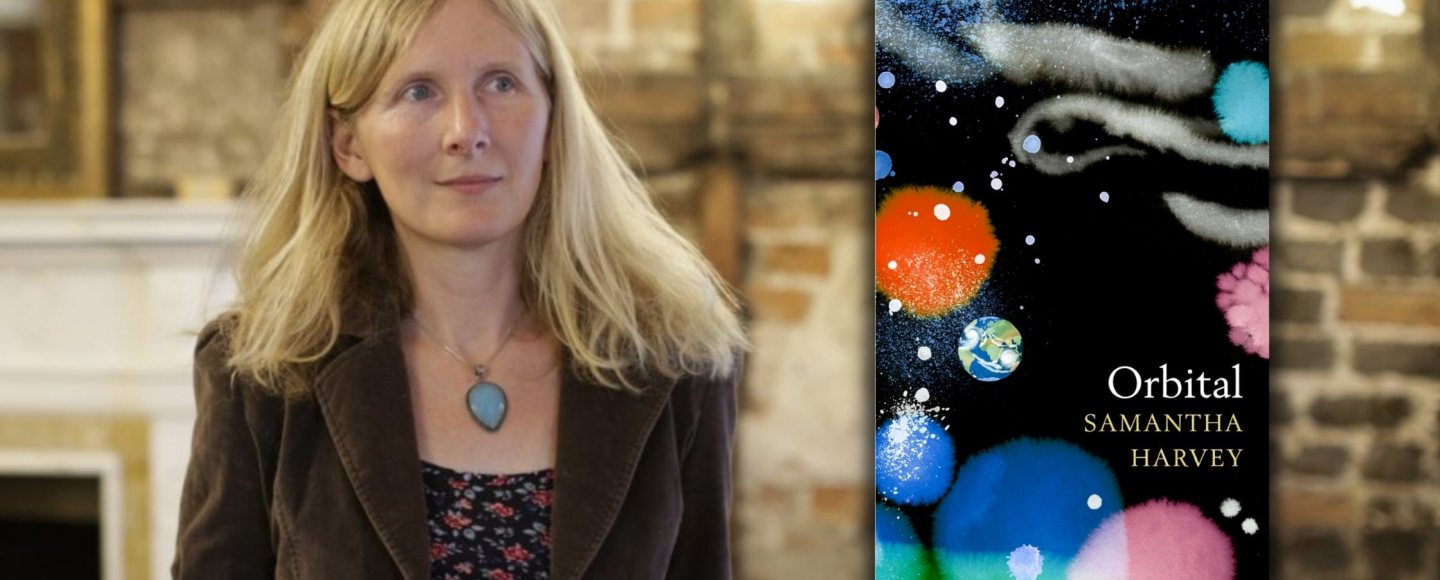
The real-life episode uncannily resembles a fictional scene from Samantha Harvey’s 2024 Booker Prize winning novel Orbital, in which an ISS astronaut ignores a lump on his neck because he does not want two others to be forced to evacuate the space station ahead of time due to his medical issue.
Harvey’s novel is not only a literary ode to the astronauts and scientists who make space travel and research possible – supplying data in fields as varied as weather forecasts to marine sciences to human health – it is also a philosophical treatise in its own soul-stirring way, calling for global harmony, and an environmentalist manifesto for making peace with the planet and each other.
Exquisitely written, with not a single extraneous word or line – much like the space constraints on the ISS that require discipline of movement and consumption – Orbital (Penguin Random House, ₹499) is a little book with vast depth, an exploration of outer space and inner truths.
Here are 10 quotes and moments from the book that take your breath away.

1. “When we’re on that planet we look up and think heaven is elsewhere, but here is what the astronauts and cosmonauts sometimes think: maybe all of us born to it have already died and are in an afterlife. If we must go to an improbable, hard-to-believe-in place when we die, that glassy, distant orb with its beautiful lonely light shows could well be it.” (p.9)
Chie, one of the astronauts, has been informed of her mother’s passing away. Her father had died a decade ago, leaving her an orphan. Orbiting space, she has no way to attend her mother’s funeral and last rites. All that Chie and her fellow astronauts can do is look back at the planet they are from, and understand the link between the words mother and earth…
2. “So strenuously unrobotic is the astronaut’s heart that it leaves the earth’s atmosphere and it presses out – gravity stops pressing in and the counterweight of the heart starts pressing out, as if suddenly aware it is part of an animal, alive and feeling. An animal that does not just bear witness, but loves what it witnesses.” (p.35)
Pietro reflects on his own love for the planet and his desire to study astronomy. Each time he looks into the camera and sets up the equipment to study light and temperate on earth, he feels his heart banging – literally and metaphorically –against his ribs as he films.
3. “This feels to her what separates her universe and Shaun’s – a tree made by the hand of nature, and a tree made by the hand of an artist. It’s barely any difference at all, and the profoundest difference in the world.” (p.45)
Nell, an atheist, is contemplating her difference of opinion on the topic of God with her colleague Shaun, who wears a cross on a chain around his neck. Nell wonders what else could have created the universe but a “heedless hurtling beautiful force”. But she doesn’t ask him because she expects him to look out into the deep, multidimensional darkness around them and reply, “what made that but some heedful hurling beautiful force?”
4. “Why would you do this? Trying to live where you can never thrive? Trying to go where the universe doesn’t want you when there’s a perfectly good earth just there that does. He’s never sure if man’s lust for space is curiosity or ingratitude. If this weird hot longing makes him a hero or an idiot. Undoubtedly something just short of either.” (p.49)
Shaun ruminates about his love for space travel and misses his wife back on earth, who encouraged him to make the journey to ISS.
5. “Because of ongoing political disputes please use your own national toilet. The idea of a national toilet has caused some amusement among the crew. I’m just going to take a national pee, Shaun will say. Or Roman: Guys, I’m going to go and do one for Russia.” (p.63)
Russians and Americans have their own separate toilets on the ISS but its inhabitants don’t really follow earthly rules and flagrantly disregard political edicts. The ground crew watching the security cameras conclude that astronauts and cosmonauts are like cats: “intrepid, cool, and can’t be herded.”
6. “When the six of them talked about their spacewalks afterwards, they described déjà vu – they knew they’d been there before. Roman said that perhaps it was caused by untapped memories of being in the womb. That’s what floating in space feels like for me, he’d said. Being not yet born.” (p.71)
Nell is spacewalking for routine maintenance work on the ISS – she has been out there about seven hours – and is looking at earth below her feet, “a sight of such magnificence it shoots your senses apart”. She remembers her desire to fly when she was a child, and compares it with this “unearthly” experience of drifting in a blackness which is “alive, and breathing and beckoning”.
7. “They come to see the politics of want. The politics of growing and getting, a billion extrapolations of the urge for more, that’s what they begin to see when they look down. They don’t even need to look down since they, too, are part of those extrapolations, they more than anyone – on their rocket whose boosters at lift-off burn the fuel of a million cars.” (p.75)
In outer space, looking down at earth, the newsfeed appears initially to the astronauts as a “babbling pantomime of politics”. But, as time goes by and they develop protective feelings towards the planet, they realise to their horror how the inanity and insanity of human politics has demolished, destroyed and distorted permanently large swathes of earth and its systems – “a planet contoured and landscaped by want.”
8. “Everything in his body seems to lack commitment to the cause of its animal life, as if there’s a cooling of systems, an efficient running-down of superfluous parts. In the slowing and cooling he hears his thoughts more, they’re distant bells chiming one at a time in his head.” (p.80)
Pietro considers the effect of space travel on his human form, how it will deplete his muscles and leave him “all head and no body” – a description that really makes one marvel at the kind of physical fitness and temperament it requires to be an astronaut in outer space. It also points at the sense of mission – and madness – it takes to follow one’s purpose to the end; or as Shaun later thinks, “a self-determination and belief that burns up everything else in its path” (p.103).
9. “We exist now in a fleeting bloom of life and knowing, one finger-snap of frantic being, and this is it. This summery burst of life is more bomb than bud. These fecund times are moving fast.” (p.114)
The history of earth is narrated as a “cosmic calendar”, so that while the astronauts sleep, disoriented about time and space, entire aeons have passed by, from the ferocious Big Bang 14 billion years ago to the present, fluid, untameable moment.
10. “Our lives here are inexpressibly trivial and momentous at once, it seems he’s about to wake up and say. Both repetitive and unprecedented. We matter greatly and not at all. To reach some pinnacle of human achievement only to discover that your achievements are next to nothing and that to understand this is the greatest achievement of any life, which itself is nothing, and also much more than everything.” (p.121)
Pietro takes stock of his life as he sleeps and dreams. Tomorrow will be the same as today, and yet completely different. The space station will orbit the earth 16 times, witnessing 16 sunrises and sunsets. Four astronauts will leave, and four others will come on board the ISS. Some day, the ISS too may cease to be. Life will end, and go on.
Sometimes it takes a book about outer space to wake us up to the beauty of our precious, momentary lives on earth.
Discover more from eShe
Subscribe to get the latest posts sent to your email.
 eShe
eShe 
0 comments on “10 moments from Samantha Harvey’s ‘Orbital’ that are out of this world”