

By Neer Bukharia and Smriti Sinha
Ordering ice cream at 3 a.m., and delivery is just 10 minutes? Or hiring a beautician to come home with professional products and equipment at half the price of a salon visit? Taxi at your doorstep in three minutes? Doesn’t raise an eyebrow anymore, does it?
But behind these luxuries that city-dwellers now take for granted in India – powered by a large network of people, companies, policies and technologies collectively called the gig economy – lies an underbelly of socioeconomic compulsions and income inequality, especially for women.
First things first. Who is a gig worker? Gig work is an overarching term that covers contractual, freelance, informal and non-traditional services. In the past decade, platform-based gig work has taken off in a big way in India and worldwide, powered by large tech companies. These services range from blue-collar labour like domestic helpers, delivery-persons, and ride-sharing cab drivers, to white-collar labour like coders.
The uncertain nature of gig work could be a reason why it is often not considered during the formulation of labour laws. However, the increasing number of gig workers worldwide might be a pointer that the gig economy model is the direction most countries are taking. According to a 2022 Niti Aayog report, ‘India’s Booming Gig and Platform Economy’, the gig workforce is expected to expand to 23.5 million workers by 2029–30.
Not all rosy
But discrimination prevails. Gig workers are hired part-time, are underpaid, have no employment security, and in most cases, are not even considered “employees”. Their secondary status could be a reason for their exclusion from discussions concerning worker rights and empowerment.
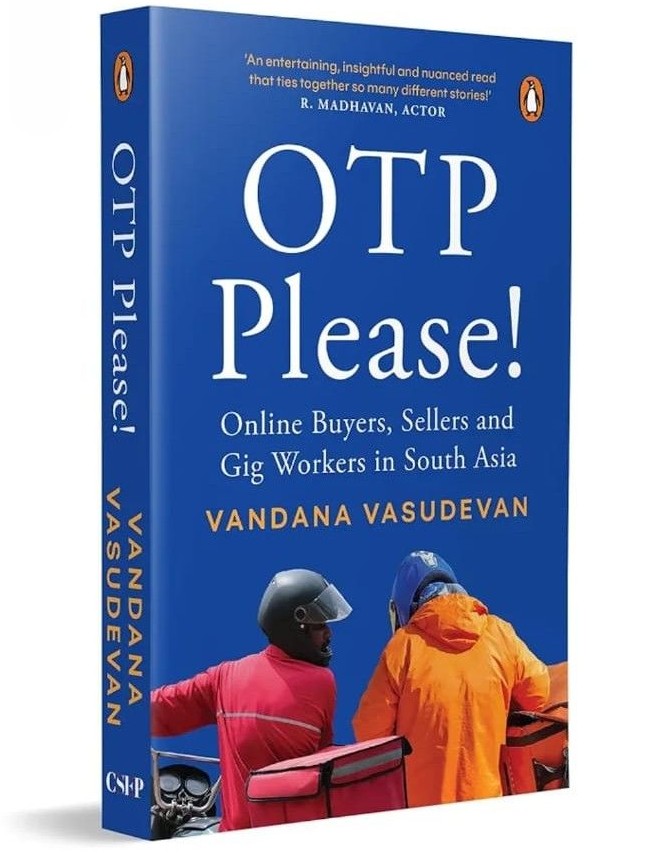
In this context, Vandana Vasudevan’s OTP Please!: Online Buyers, Sellers and Gig Workers in South Asia (Penguin Random House India, ₹499) is a must-read. The author, who is a development researcher and columnist, brings to us human stories behind South Asia’s app economy, covering gig workers, customers and small-time sellers. And not to forget, the invisible boss: the platform.
Covering what she calls the Planet of the Apps, her work explores factors such as economic opportunities, freedom, women, oppression, anxiety, and gender-related issues.
Vasudevan interviews an Amazon warehouse employee, Nisha, to learn how MNCs have been able to maintain a thriving, profitable business at the cost of cheap labour. Nisha shares how workers are easily replaceable and fired. According to labour laws, if a person has been working at a place for 240 days, they should be made a permanent employee. Amazon saves its costs allegedly by firing people before they complete that period, and rehiring them after a couple of months.
Nisha also reveals the subtle discrimination prevalent. People with athletic, agile physiques are preferred, as the job requires moving swiftly and a minimum of 15 km walking daily! The employees are allegedly not given any stools, so they are on their feet, working throughout the shift. They get two breaks of 30 minutes each. Every step is recorded. There is even a warning email if you happen to spend more than 10 minutes in the washroom. With limited chances of improvement, your third mistake could cost you your job.
Worse for women
As per the World Economic Forum, India ranks 135 out of 146 countries in the Global Gender Gap Index. Gender Inequality Report 2022 highlights the glaring difference in gender disparity, where Indian men earn 82 percent of the income, and women only 18 percent.

Vasudevan explains how the app economy has brought a change in the quality of life for professional women. After a long day at work, apps such as Swiggy and Zomato allow them some freedom from household chores such as cooking. They can focus on their careers with virtual services assisting them in taking care of household responsibilities.
However, women working for these platforms continue to be economically exploited. The reality gets harsher as mostly it is women from below the poverty line, rural households, and single mothers who often take on gig jobs, which promise them flexibility to manage both income and households.
A paper by ISB confirms that “while the gig economy promises flexibility and opportunity for women, gender biases and structural barriers limit their participation and success.”
It points out that the reality is more nuanced for Indian women. “Due to economic restrictions that stem from men still being the key decision makers for household purchases, two factors determining women’s participation in the gig economy – access to the internet and smartphones – continue to favour men,” it says.
In their study ‘Engendering India’s Gig Economy‘, scholars Anweshaa Ghosh and Risha Ramachandran point out that while some women-oriented companies and platforms provide limited information on the sexual harassment law, most workers remain unaware of the redressal mechanism.
More barriers
The labour force performance rate for women in India rose to 41.7 percent in 2024, according to the Periodic Labour Force Survey conducted by India’s Ministry of Statistics and Programme Implementation. It goes without saying that gig workers have contributed to this uptick. But do the rising numbers also mean that the conditions are conducive for women workers in the gig economy? Not really, according to several reports by researchers and independent media.
Take the case of Nirali, a 20-year-old gig worker in Delhi. Speaking to eShe, Nirali shares that she has been working since the age of 13. She came to the city from her village for a better “education”. However, the high cost of living forced her to take on odd jobs such as sewing, henna and domestic work instead.

Her salary for working four hours every day throughout the month, with zero employment security, is about ₹5,000 – 6,000 per month. She realises that her limited formal education is an obstacle to switching to organised, better-paying work. Her coming from a marginalised caste has also been an impediment, and Nirali has had to face rejection at many places, she says.
Nirali’s story – and that of many others – underscores why the gig economy continues to thrive in India. Rising unemployment, limited access to quality education, lack of skilled jobs, and caste stigma are some of the factors that propel women to the gig economy, and maybe keep them there.
The experiences of workers that Vasudevan shares in the book, too, justify the situation: it is bittersweet. Individuals have some source of income, but it all comes at a cost. There is a trade-off.
So, the next time you click a few buttons to order a last-minute birthday gift or your daily groceries, spare a thought for the people behind that quick delivery. Behind your convenience is someone else’s compulsion.
Lead image: Mlenny
Discover more from eShe
Subscribe to get the latest posts sent to your email.
 eShe
eShe 
Useful reading for a relatively unknown subject:
Thank you!
LikeLike