


My life has been eventful by any standard. But earlier this year, when a docu-drama was released on Valentine’s Day about my love story, it helped me put all those events in context and make sense of everything.
The story itself, which I had shared on India Love Project, is not so unlikely – a divorcee with two kids falls in love and gets married again. So, the fact that it made it to an Amazon Prime web series produced by Karan Johar’s Dharmatic Productions surprised me no end.
(My Indian-American cousin noted that this itself is a sad commentary on Indian society: a young mother falling in love is such a radical concept that it gets so much attention even in the 21st century. He predicted it would take at least two more generations for Indians to make peace with the idea of mothers being women too.)
Though I had agonised about the release of this web series Love Storiyaan for over a year, what came next completely changed my way of looking at my life journey.
My husband and I were inundated with messages from people who knew us and recognised us, and also many more from complete strangers who reached out to share their own stories.
Many women – especially those in their 30s or older – got inspiration and hope about finding love at a later age. Mothers – married or divorced – related to my inner struggle with sexuality versus motherhood. Wives stuck in bad marriages identified with the burden of not being able to leave if they had a son.
(I was able to fly to freedom along with both pieces of my heart intact only because I had daughters in a society that thinks nothing of them.)
Just when I’d assume that the attention around the documentary would die down, yet another woman would reach out and share a heartfelt note on how it affected her. Or an acquaintance I’d met just once would drop in home to take guidance on her unhappy marriage. Or a power-woman I’d interviewed years ago would call unexpectedly to unload her deep dark secret of a forbidden love. Or an Indian-American I’d never met would drive five hours from Malibu to Las Vegas to tell me in person why she could only leave her violent marriage after her sons turned 18.
Or a middle-aged stranger would walk up to me at a gathering, hold my hand and tell me with earnest eyes, “You did the right thing.” Or one of my daughters would share a screenshot of a friend’s message, a young adult telling his mother, “Mom, did I trouble you so much when you remarried?”
A call and a calling
One evening, I got a call that left me with goosebumps. A fellow peaceworker in the US, a 65-year-old Pakistani-origin physician and mother of three, who lost her husband to Covid four years ago, told me she accepted a marriage proposal from a family friend because of the documentary. It inspired her to give remarriage a chance and to make the most of the rest of her life. They got married on Mother’s Day.
I didn’t sleep that night after the phone call. I saw my whole life flash in front of my eyes – all the terrible suffering of my first marriage and the torrid secrecy of my romance and the gut-wrenching struggle of putting myself before my own children.
“So that’s why You made me go through all that,” I whispered to God in the darkness, tears of humility and gratitude rolling down my face and hair, streaking my pillow. “So that a 65-year-old widow on the other side of the world would give love a second chance.”
For the past 20 years, I have followed the practice of Nichiren Buddhism, and we use the term ‘Bodhisattvas of the Earth’ a lot. It’s a powerful framing tool that helps us see our lives in a larger context, and helps give a deeper meaning to our problems and challenges.
It’s a Bodhisattva’s job and duty to inspire others by being an example of resilience, fortitude and faith. A Bodhisattva soul chooses a difficult life so that she may give courage to others by rising above those difficulties. A Bodhisattva soul willingly manifests unhappy circumstances so that he can be a paragon of indestructible happiness – that which is not defined by external circumstances.
It’s been 20 years of such framing, especially during the toughest moments of my life. Twenty years of not giving up, of striving onward in each moment. Twenty years of healing and cultivating happiness. Twenty years of conviction that all my challenges are part of my soul’s calling for this lifetime, and that my life has a larger purpose than I can see with my mortal eyes.
So when I talked to God that night, it was this word that came to mind. “I suppose this is what it means to be a Bodhisattva, to voluntarily assume the appropriate karma so that, in overcoming it, one inspires others too. Just as the lotus flower blooms and seeds at the same time.”

Light after the darkness
I met my former boss’s wife, a fellow Buddhist practitioner, this week at an event. She had seen the documentary and had recognised me from years ago. The septuagenarian looked at me thoughtfully, then said, “What struck me is how happy you looked. We hear of people (who practice Buddhism) turning things around even after undergoing a lot of suffering. Now I have seen it with my own eyes.”
Perhaps the documentary strengthened her faith a bit more. It surely strengthened mine. I am now even more grateful.
That I was given the opportunity to undergo trials.
That I was given the strength to fight them.
That I was blessed with the Grace to find the right spiritual path.
That someone made a film about my journey, which inspired countless others.
And that I was able to contextualise my struggles, resolve leftover fears, forgive my foolish heart, and make peace with my past after the film was released.
I’m only 50. If all this has happened in the first half of my life, I can’t wait to see what the next half holds.
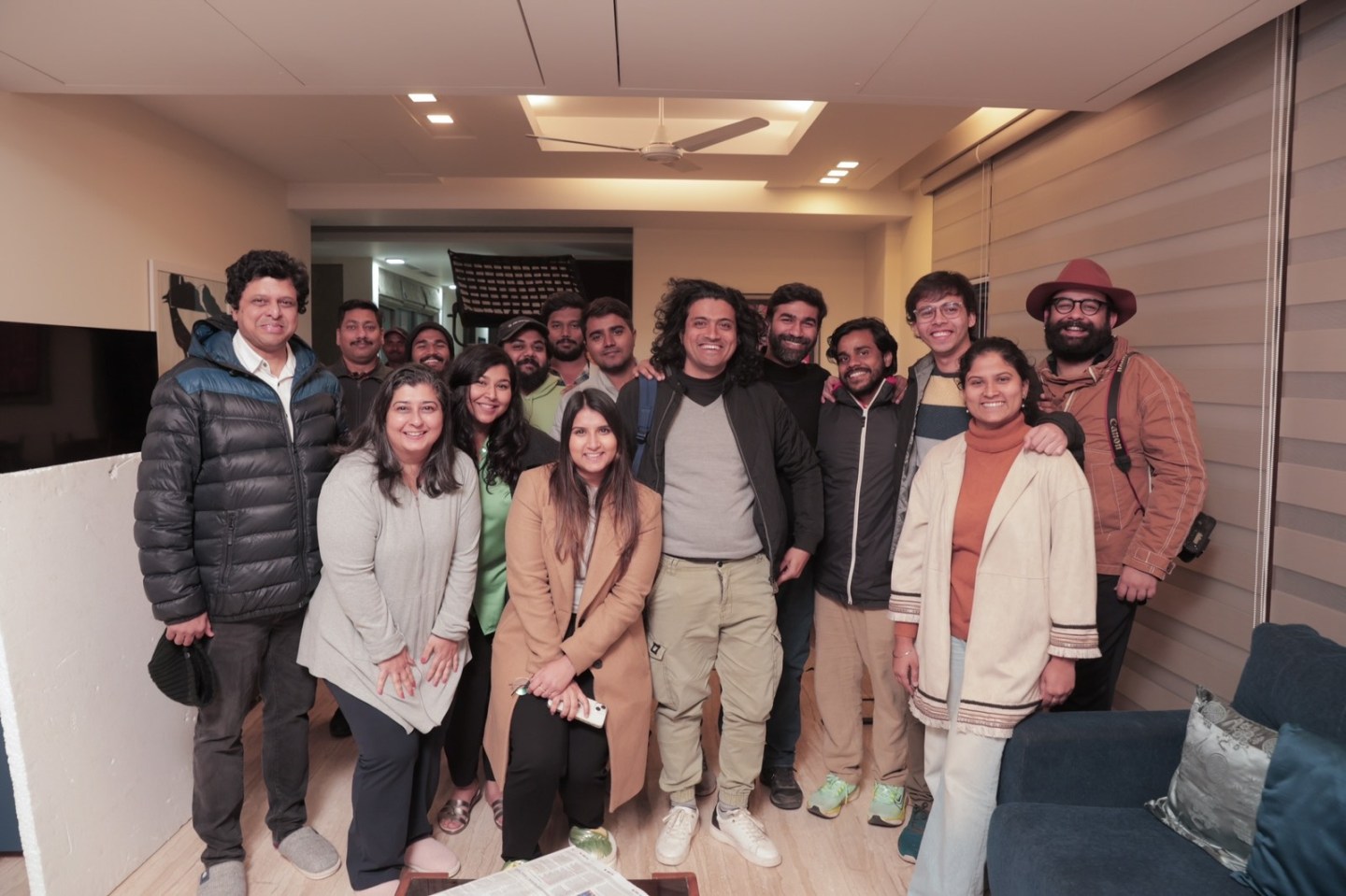
Lead image: Ullekh and I during the shoot
Discover more from eShe
Subscribe to get the latest posts sent to your email.
 eShe
eShe 
Salute! Love your story!
LikeLiked by 1 person
Aekta, you made a good decision to get married again with your ex husband which is certainly inspirational and motivational for countless other women tofollow it. No doubt it is a good story for a docudrama. Kudos and shabbash! Shakil Ahmed (Shokee)Lahore Pakistan
LikeLike